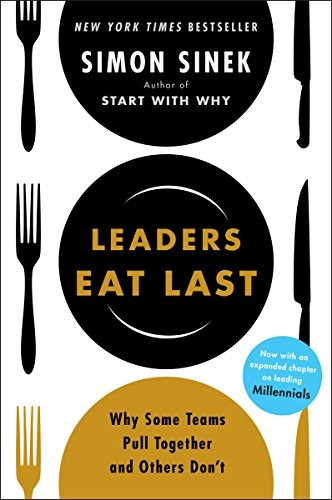
Talk to Leaders Eat Last like its author wrote you back.
Get the ideas that fit your life — not generic summaries.
- Chat with the book
- Audiobook-style main ideas
- Adapts to your life and goals
- Helps you take action
Leaders Eat Last, in detail
Leaders Eat Last is Simon Sinek's argument that the best organizations run on a feeling he calls the Circle of Safety — an environment where people trust that the people above them in the hierarchy have their interests at heart. The title comes from a Marine Corps tradition: officers eat only after their troops have been fed. Sinek uses this as a lens to explain why some teams are exceptional and others merely functional.
The book is built on a biological frame. Sinek identifies four chemicals that drive human behavior at work: endorphins (mask pain, enable effort), dopamine (reward task completion), serotonin (status and pride), and oxytocin (trust and belonging). Most modern workplaces pump dopamine through metrics, bonuses, and constant feedback loops while starving people of oxytocin. The result is short-term performance at the cost of loyalty, safety, and genuine collaboration.
The second half of the book traces how the Circle of Safety has been eroded in corporate America. Sinek is particularly critical of quarterly capitalism — the pressure to report good earnings every ninety days — which he argues forces leaders to sacrifice their people for the numbers. He draws on case studies from the military, Southwest Airlines, and Barry-Wehmiller to argue that companies that genuinely protect their people outperform those that treat headcount as a variable cost.
Where Sinek is strongest is in making the emotional contract between leader and employee concrete. The leader's job is not to do all the work but to create an environment where others can do their best work without fear. That means absorbing the uncertainty that flows down from above so it doesn't paralyze the people below. It also means eating last — accepting that your needs come after your team's needs, not as a moral performance but as a practical condition for trust.
The big ideas
- 1.
The Circle of Safety is the leader's primary job: create an environment where people feel protected from external threats and from internal politics.
- 2.
Four neurochemicals shape workplace behavior — endorphins, dopamine, serotonin, and oxytocin. Good cultures create conditions for all four; toxic cultures over-index on dopamine alone.
- 3.
Oxytocin, the trust chemical, is released through physical presence, time invested, and acts of sacrifice. It can't be hacked with a bonus.
