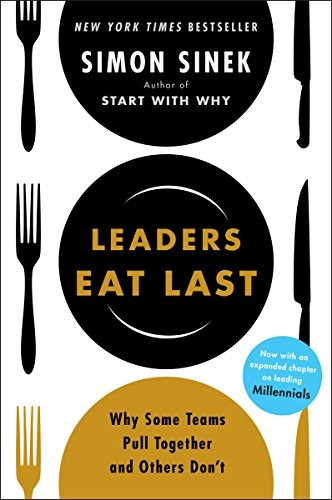
Leaders Eat Last by Simon Sinek is a 2014 business book about leadership, trust, organizational culture. The Circle of Safety is the leader's primary job: create an environment where people feel protected from external threats and from internal politics.
Summary
Leaders Eat Last is Simon Sinek's argument that the best organizations run on a feeling he calls the Circle of Safety — an environment where people trust that the people above them in the hierarchy have their interests at heart. The title comes from a Marine Corps tradition: officers eat only after their troops have been fed. Sinek uses this as a lens to explain why some teams are exceptional and others merely functional.
The book is built on a biological frame. Sinek identifies four chemicals that drive human behavior at work: endorphins (mask pain, enable effort), dopamine (reward task completion), serotonin (status and pride), and oxytocin (trust and belonging). Most modern workplaces pump dopamine through metrics, bonuses, and constant feedback loops while starving people of oxytocin. The result is short-term performance at the cost of loyalty, safety, and genuine collaboration.
The second half of the book traces how the Circle of Safety has been eroded in corporate America. Sinek is particularly critical of quarterly capitalism — the pressure to report good earnings every ninety days — which he argues forces leaders to sacrifice their people for the numbers. He draws on case studies from the military, Southwest Airlines, and Barry-Wehmiller to argue that companies that genuinely protect their people outperform those that treat headcount as a variable cost.
Where Sinek is strongest is in making the emotional contract between leader and employee concrete. The leader's job is not to do all the work but to create an environment where others can do their best work without fear. That means absorbing the uncertainty that flows down from above so it doesn't paralyze the people below. It also means eating last — accepting that your needs come after your team's needs, not as a moral performance but as a practical condition for trust.
Talk to Leaders Eat Last like its author wrote you back.
Get the ideas that fit your life — not generic summaries.
- Chat with the book
- Audiobook-style main ideas
- Adapts to your life and goals
- Helps you take action
Key takeaways
- 1.
The Circle of Safety is the leader's primary job: create an environment where people feel protected from external threats and from internal politics.
- 2.
Four neurochemicals shape workplace behavior — endorphins, dopamine, serotonin, and oxytocin. Good cultures create conditions for all four; toxic cultures over-index on dopamine alone.
- 3.
Oxytocin, the trust chemical, is released through physical presence, time invested, and acts of sacrifice. It can't be hacked with a bonus.
- 4.
Leaders who eat last signal that the organization's mission and people matter more than personal comfort or status — and that signal changes everything.
- 5.
Quarterly capitalism forces short-term thinking that destroys the Circle of Safety. Leaders who protect their people even against shareholder pressure build stronger organizations.
- 6.
The best military units aren't distinguished by superior equipment but by the depth of trust soldiers have in each other and their officers.
- 7.
Abstract empathy — caring about distant customers or shareholders — is easier than concrete empathy for the person sitting next to you. Leaders who confuse the two often harm both.
- 8.
Leadership is not a rank but a choice. Anyone who chooses to look after the person next to them is exercising leadership.
Discussion questions
Use these on your own, with a book club, or as chat starters in Superbook. Book club version, ready to copy or print →
- 1.
Think of a leader who made you feel inside the Circle of Safety. What specifically did they do that created that feeling?
- 2.
Sinek argues that dopamine-heavy cultures feel energetic but are actually fragile. Where in your organization do you see this dynamic playing out?
- 3.
The Marine Corps tradition of officers eating last is a ritual. What rituals in your team signal that the leader puts people first — or signal the opposite?
- 4.
Sinek is critical of quarterly capitalism. If your organization runs on quarterly targets, what specifically gets sacrificed at the end of each quarter? Who bears that cost?
- 5.
Oxytocin builds through time and sacrifice, not through policy. What's something you could do this week that would cost you something but build genuine trust with your team?
- 6.
Have you ever worked for someone who ate last? What was different about that team compared to teams where the opposite was true?
- 7.
Sinek distinguishes between leaders who care about the people in front of them and those who care about abstract groups like 'customers' or 'shareholders.' Which type were your best managers?
- 8.
What does it feel like to work inside a Circle of Safety? Can you tell within a week of joining a team whether the circle exists?
- 9.
The book argues that fear and anxiety at work are not motivators but symptoms of a broken leadership environment. Do you agree? Where does healthy pressure end and corrosive fear begin?
- 10.
If you lead a team, what are the two or three things you do regularly that signal 'I've got your back'? Are you sure your team reads those signals the way you intend?
- 11.
Barry-Wehmiller kept every employee during the financial crisis by sharing the pain across the whole organization. Would that choice be possible in your organization? What would make it possible or impossible?
- 12.
Sinek says the big threats come from outside the Circle and leaders help the team face them together. What's the biggest external threat your team faces right now, and how is your leader handling it?
Themes
Frequently asked questions
-
Is Leaders Eat Last worth reading?
Yes, especially for anyone in a management role who wants to understand why some teams hold together under pressure and others don't. The biological frame is accessible and the case studies are vivid. The critique of short-term corporate thinking is pointed and worth sitting with. Some readers find the military analogies over-extended, but the core argument is sound.
-
How long does it take to read Leaders Eat Last?
Roughly five hours at an average reading pace for the 288-page book. Sinek writes in a narrative style that reads quickly, though some readers slow down in the middle chapters where the neurochemistry detail is thickest.
-
What is the main idea of Leaders Eat Last?
The best leaders create environments where people feel safe enough to give their best. They do this by absorbing uncertainty from above and shielding their teams from internal politics — and by consistently demonstrating, through actions not words, that the people in their care matter more than their own comfort.
-
What does 'leaders eat last' actually mean?
It's a literal Marine Corps practice: officers wait until all enlisted personnel have eaten before serving themselves. Sinek uses it as a metaphor for any leadership behavior where the leader's needs come after the team's needs — whether that's taking blame before credit, or turning down a bonus when the team didn't earn a raise.
-
Who should read Leaders Eat Last?
Managers, executives, and anyone trying to understand why their workplace feels unsafe or political. It's especially useful for new managers who want a framework for thinking about their responsibilities before they develop bad habits.
Similar books
Leaders Eat Last vs.
Deciding between two books? Leaders Eat Last vs Extreme Ownership .
