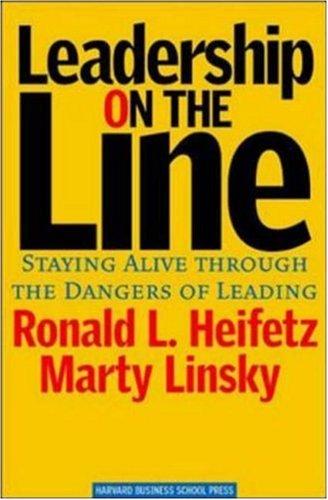
Talk to Leadership on the Line like its author wrote you back.
Get the ideas that fit your life — not generic summaries.
- Chat with the book
- Audiobook-style main ideas
- Adapts to your life and goals
- Helps you take action
What it argues
Leadership on the Line is Ronald Heifetz and Marty Linsky's more accessible treatment of adaptive leadership, aimed at practitioners rather than scholars. The central premise is stated plainly at the start: leadership is dangerous. When leaders mobilize people to do adaptive work — work that requires people to give up something they value — they face predictable forms of resistance that can end careers, derail efforts, and occasionally do worse. The book is an attempt to name those dangers clearly and give leaders enough self-awareness to navigate them.
The first half maps the landscape of risk. Heifetz and Linsky describe how organizations marginalize, divert, attack, and seduce people who are challenging the status quo. Marginalization pushes a leader to the fringe, making their concerns seem eccentric rather than central. Diversion loads them with work that drains their capacity to drive the core issue. Attack mobilizes opposition against the person rather than their ideas. Seduction is subtler: offering the leader rewards — popularity, inclusion, recognition — that require compromising the change they set out to make.
What it gets right
- 1.
Leadership is dangerous because adaptive change requires people to give up things they value, and those people will resist — often by attacking or sidelining the leader rather than engaging with the challenge.
- 2.
Organizations marginalize, divert, attack, and seduce people who challenge the status quo. Understanding which tactic is being used in a given moment is essential for responding effectively.
- 3.
Getting on the balcony — stepping back from the action to observe the system — is a discipline, not a one-time act. It must be practiced throughout any adaptive effort.
What it covers
Who wrote it
Ronald A. Heifetz is a co-founder of the Center for Public Leadership at the Harvard Kennedy School and the originator of adaptive leadership theory. His earlier book Leadership Without Easy Answers established the technical-adaptive distinction that runs through all his subsequent work. Marty Linsky is a former Massachusetts state legislator, attorney, and longtime Harvard Kennedy School faculty member who has been Heifetz's primary co-author and collaborator. Together they founded Cambridge Leadership Associates to train leaders in adaptive practice across sectors and countries.
