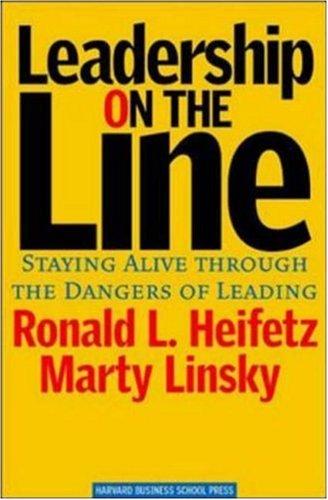
Talk to Leadership on the Line like its author wrote you back.
Get the ideas that fit your life — not generic summaries.
- Chat with the book
- Audiobook-style main ideas
- Adapts to your life and goals
- Helps you take action
Leadership on the Line, in detail
Leadership on the Line is Ronald Heifetz and Marty Linsky's more accessible treatment of adaptive leadership, aimed at practitioners rather than scholars. The central premise is stated plainly at the start: leadership is dangerous. When leaders mobilize people to do adaptive work — work that requires people to give up something they value — they face predictable forms of resistance that can end careers, derail efforts, and occasionally do worse. The book is an attempt to name those dangers clearly and give leaders enough self-awareness to navigate them.
The first half maps the landscape of risk. Heifetz and Linsky describe how organizations marginalize, divert, attack, and seduce people who are challenging the status quo. Marginalization pushes a leader to the fringe, making their concerns seem eccentric rather than central. Diversion loads them with work that drains their capacity to drive the core issue. Attack mobilizes opposition against the person rather than their ideas. Seduction is subtler: offering the leader rewards — popularity, inclusion, recognition — that require compromising the change they set out to make.
The second half is about staying alive — the authors' metaphor for maintaining the capacity to lead through sustained resistance. It covers finding allies, knowing your hungers and loyalties, managing the personal toll of leadership, and keeping the work anchored in purpose rather than personal survival. The advice is practical without being formulaic: it reads as wisdom from two people who have watched many leadership efforts fail in patterned ways.
The book is shorter and more personal than The Practice of Adaptive Leadership and serves as a better entry point to Heifetz's work. The emphasis throughout is on the human cost of leading real change, and on the self-knowledge required to navigate that cost without either giving up or burning out.
The big ideas
- 1.
Leadership is dangerous because adaptive change requires people to give up things they value, and those people will resist — often by attacking or sidelining the leader rather than engaging with the challenge.
- 2.
Organizations marginalize, divert, attack, and seduce people who challenge the status quo. Understanding which tactic is being used in a given moment is essential for responding effectively.
- 3.
Getting on the balcony — stepping back from the action to observe the system — is a discipline, not a one-time act. It must be practiced throughout any adaptive effort.
