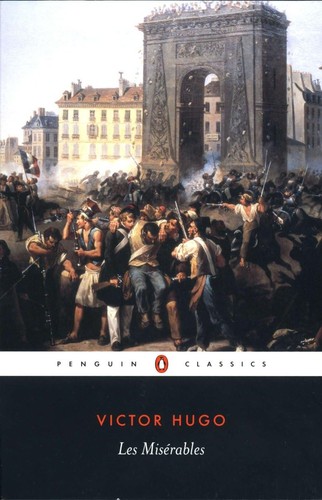
Talk to Les Misérables like its author wrote you back.
Get the ideas that fit your life — not generic summaries.
- Chat with the book
- Audiobook-style main ideas
- Adapts to your life and goals
- Helps you take action
What it argues
Jean Valjean is paroled after nineteen years in prison — five for stealing bread, fourteen more for escape attempts — and finds that the law, in the person of the relentless Inspector Javert, will never truly release him. After a single act of generosity from a bishop transforms him, Valjean reinvents himself as a factory owner and mayor, but Javert tracks him across decades, across the Paris barricades of 1832, and into old age. The chase is the novel's spine, but Hugo's ambitions are far larger: Les Misérables is an attempt to render an entire civilization in the grip of its own injustice.
The book is several novels in one. There is the melodrama of Valjean and Javert. There is the story of Fantine, the abandoned mother, and her daughter Cosette. There is the revolutionary subplot centered on the Café ABC students who die on the barricades in a failed uprising. And there are the Hugo digressions — some famously lengthy, including fifty pages on the Battle of Waterloo and an extended essay on the Paris sewer system — that represent the author's conviction that a novel about poverty must also be a novel about all the systems that produce it.
What it gets right
- 1.
Valjean's transformation after the bishop's generosity is the theological center of the novel: grace is gratuitous and can undo a life shaped entirely by punishment.
- 2.
Javert is not a villain but a man whose entire identity is the law. His suicide is more tragic than Valjean's suffering because he cannot survive the discovery that justice and mercy are incompatible.
- 3.
Hugo's social argument is structural, not merely individual: poverty is produced by systems, and punishing the poor for poverty is the central cruelty the novel names and anatomizes.
What it covers
Who wrote it
Victor Hugo (1802–1885) was a French poet, playwright, and novelist who dominated French Romanticism and is considered one of the greatest writers in the French literary tradition. His major works include The Hunchback of Notre-Dame (1831), Les Misérables (1862), and extensive poetry collections. Hugo was also a prominent political figure who opposed Napoleon III's coup and spent nineteen years in exile. He returned to France in 1870 and was received as a national hero.
