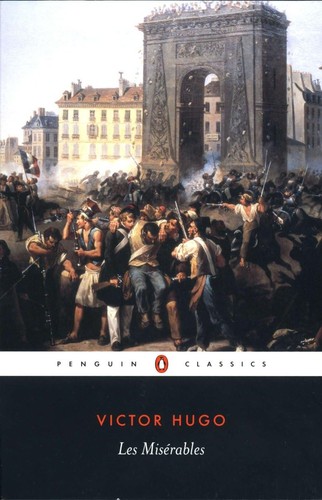
Les Misérables by Victor Hugo is a 1862 classics book about justice and mercy, poverty and social inequality, redemption. Valjean's transformation after the bishop's generosity is the theological center of the novel: grace is gratuitous and can undo a life shaped entirely by punishment.
Summary
Jean Valjean is paroled after nineteen years in prison — five for stealing bread, fourteen more for escape attempts — and finds that the law, in the person of the relentless Inspector Javert, will never truly release him. After a single act of generosity from a bishop transforms him, Valjean reinvents himself as a factory owner and mayor, but Javert tracks him across decades, across the Paris barricades of 1832, and into old age. The chase is the novel's spine, but Hugo's ambitions are far larger: Les Misérables is an attempt to render an entire civilization in the grip of its own injustice.
The book is several novels in one. There is the melodrama of Valjean and Javert. There is the story of Fantine, the abandoned mother, and her daughter Cosette. There is the revolutionary subplot centered on the Café ABC students who die on the barricades in a failed uprising. And there are the Hugo digressions — some famously lengthy, including fifty pages on the Battle of Waterloo and an extended essay on the Paris sewer system — that represent the author's conviction that a novel about poverty must also be a novel about all the systems that produce it.
Hugo's prose is rhetorical, operatic, and unapologetically sentimental. He wants to move you, and he largely succeeds. The moral architecture is clear: the state punishes the poor for surviving poverty; only grace — in the religious sense that Myriel embodies and that Valjean internalizes — can break the cycle. Javert's suicide, when he cannot reconcile mercy with the law he has served, is one of the great tragic turns in the Western novel.
This is an extraordinarily long book. The abridged versions lose essential material, but the unabridged version requires real commitment. Hugo's digressions test modern patience, and some sections — particularly the Waterloo sequence — feel like separate volumes. But readers who give themselves to it find that no adaptation (and there have been many) fully captures its ambition. The musical catches the emotional peaks; the novel catches everything around them, which is where Hugo's argument lives.
Talk to Les Misérables like its author wrote you back.
Get the ideas that fit your life — not generic summaries.
- Chat with the book
- Audiobook-style main ideas
- Adapts to your life and goals
- Helps you take action
Key takeaways
- 1.
Valjean's transformation after the bishop's generosity is the theological center of the novel: grace is gratuitous and can undo a life shaped entirely by punishment.
- 2.
Javert is not a villain but a man whose entire identity is the law. His suicide is more tragic than Valjean's suffering because he cannot survive the discovery that justice and mercy are incompatible.
- 3.
Hugo's social argument is structural, not merely individual: poverty is produced by systems, and punishing the poor for poverty is the central cruelty the novel names and anatomizes.
- 4.
The 1832 Paris uprising in the novel was a failed revolution, not the one usually romanticized. Hugo is clear-eyed about the difference between heroism and futility, and the barricade deaths are genuinely wasted.
- 5.
Cosette and Marius are the novel's weakest elements by common consent — they exist to embody idealized innocence and romantic love, respectively, and both are underdeveloped compared to the major figures.
- 6.
The sewer chapters are not a digression: Hugo is showing where civilization puts what it wants to forget, and Valjean carrying Marius through the Paris sewers is the novel's most compressed image of redemptive labor.
- 7.
The novel insists on the specificity of poverty — what hunger does to people, what imprisonment does to identity — in a way that makes the melodrama feel rooted rather than escapist.
- 8.
Les Misérables was immediately adapted, imitated, and read across class lines. Its emotional directness was understood by readers who found the philosophical digressions impossible, which is part of Hugo's democratic intention.
Discussion questions
Use these on your own, with a book club, or as chat starters in Superbook. Book club version, ready to copy or print →
- 1.
Hugo presents Valjean's transformation as sudden and total after one act of grace. Is that psychologically plausible, or does the novel require you to accept it on faith for the rest to work?
- 2.
Javert cannot survive the discovery that mercy exists. Is he a tragic figure, a cautionary tale about legalism, or something else?
- 3.
The 1832 uprising fails entirely. How does Hugo want us to feel about Enjolras and the students on the barricade — as heroes, fools, or both?
- 4.
Fantine's story is the most brutal in the novel. Does it feel like honest social documentation to you, or like melodrama in service of a political argument?
- 5.
Hugo is explicit that poverty is a structural problem, not a moral one. Does the novel enact that belief consistently, or does it sometimes slip into blaming individuals?
- 6.
Cosette is often criticized as the least interesting major character in the novel. Is that a failure of Hugo's imagination, or is her ordinariness thematically necessary as a counterweight to the extraordinary figures around her?
- 7.
How did you handle the digressions — the Waterloo section, the sewer essay, the convent chapters? Read carefully, skimmed, skipped? What did you lose or gain?
- 8.
Thénardier is the novel's pure villain, yet Hugo complicates him slightly at the end by having him become a slave trader in America. What does that final image accomplish?
- 9.
The musical Les Misérables is probably more familiar to most readers than the novel. If you know both, where does the musical most distort Hugo's argument?
- 10.
Is the novel ultimately optimistic about social progress, or does the death on the barricades and the survival of the Thénardiers qualify any hope it offers?
- 11.
Hugo spent seventeen years writing this book. Does it feel like a single sustained vision or a collection of ideas that don't fully cohere?
- 12.
Valjean's final years — giving everything up to let Marius and Cosette live their lives — are described almost as self-annihilation. Is that the novel's ideal of love, or a kind of pathology?
Themes
Frequently asked questions
-
Should I read the unabridged Les Misérables?
If you're committing to it, yes. The abridged versions remove the philosophical digressions, which are where Hugo's argument about social justice lives. You can read a good abridgment and get the story; you cannot read a good abridgment and get the novel. That said, it's a genuine commitment at roughly 1,500 pages.
-
Is Les Misérables hard to read?
The prose itself (in a good translation) is not difficult. The challenge is length and the digressions. The Waterloo section in particular stops the narrative cold for fifty pages. Modern readers used to plotted fiction may find these sections punishing. They are also, in their way, some of the best writing in the book.
-
How does the book compare to the musical?
The musical captures the emotional peaks beautifully and is genuinely faithful to the main plot lines. What it cannot capture is Hugo's extended social argument, the complexity of Javert's psychology, and the darkness of Fantine's story. The musical is optimistic in a way the novel is not always.
-
What is Les Misérables about, without spoilers?
A man imprisoned for petty theft who is transformed by an act of grace and spends the rest of his life being pursued by the law and trying to live up to the goodness that was given to him. Around that chase, Hugo builds a portrait of France's poor, its revolutionaries, its criminals, and its saints.
-
Who shouldn't read Les Misérables?
Readers who want tight plotting, psychological complexity in every character, or a narrative pace that doesn't stop for fifty-page essays on sewer infrastructure. The novel demands patience and a tolerance for operatic sentiment. If you want the story efficiently delivered, there are better options.