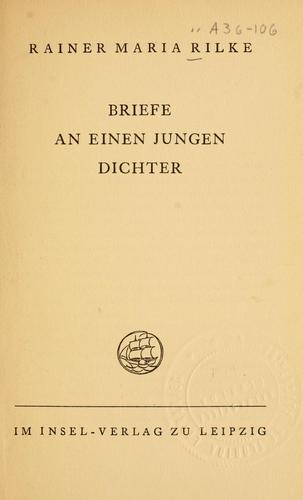
Talk to Letters to a Young Poet like its author wrote you back.
Get the ideas that fit your life — not generic summaries.
- Chat with the book
- Audiobook-style main ideas
- Adapts to your life and goals
- Helps you take action
Letters to a Young Poet, in detail
Letters to a Young Poet is a collection of ten letters Rilke wrote between 1903 and 1908 to Franz Xaver Kappus, a young military cadet and aspiring poet who had sent Rilke samples of his verse and asked for criticism. Rilke declined to evaluate the poems. What he offered instead was something harder to classify: extended meditations on the nature of artistic vocation, the necessity of solitude, the difficulty of love, and the importance of living one's questions rather than rushing toward answers. Kappus published the letters posthumously in 1929, a few years after Rilke's death.
The most quoted passage, in the first letter, sets the tone: Rilke tells Kappus to ask himself whether he must write. Not whether he wants to, not whether others think he should, but whether he would die if the possibility were taken away. This kind of testing — severe, inward, resistant to external validation — runs through all ten letters. Rilke is consistently skeptical of criticism, competition, and the need for approval as guides for the creative life. The only real question is whether the work is necessary to the person making it.
Rilke writes with great tenderness about solitude — not as deprivation but as a precondition for the kind of inner attention that art requires. He advises Kappus not to seek answers to the large questions (about love, about God, about vocation) but to learn to live inside the questions themselves. This is not evasion; it is a position about how the inner life actually develops. Certainty forecloses; openness allows. The letters that deal with love are particularly interesting: Rilke argues that most people collapse the tension of love into easy possession rather than sustaining the difficulty of two solitudes respecting each other.
As a piece of writing the letters are extraordinary, even in translation — lyrical without being ornate, specific about psychological states that are usually left vague. Their limitation is that they describe a very particular kind of artistic seriousness, one that asks a great deal of solitude and inner concentration. Rilke is talking to someone who has chosen, or is choosing, to make art the organizing principle of a life. That is not everyone's situation, and the letters do not pretend to be advice for people who have not made that choice.
The big ideas
- 1.
Ask not whether you want to write but whether you must. The only reliable test for artistic vocation is necessity — whether the absence of the work would diminish you irreversibly.
- 2.
Solitude is not loneliness. Rilke treats it as the ground in which serious inner life grows, and the precondition for any real encounter with another person.
- 3.
Live your questions. Rilke explicitly discourages rushing toward answers to large questions about love, God, or meaning — the process of living inside them honestly is the point.
