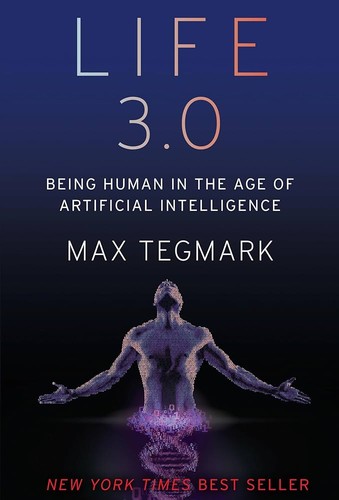
Talk to Life 3.0: Being Human in the Age of Artificial Intelligence like its author wrote you back.
Get the ideas that fit your life — not generic summaries.
- Chat with the book
- Audiobook-style main ideas
- Adapts to your life and goals
- Helps you take action
What it argues
Life 3.0 is Max Tegmark's accessible survey of the questions raised by the prospect of human-level and superhuman artificial intelligence: What are the plausible paths to AGI? How might it be deployed, and by whom? What kinds of futures are possible, from utopian to catastrophic? And what should researchers, policymakers, and the public be doing now to influence which future we get? Tegmark, a physicist at MIT who co-founded the Future of Life Institute, writes from within the AI safety research community but aims for a broader public audience than books like Bostrom's Superintelligence.
The book opens with a fictional prologue: a near-future scenario in which a secretive tech company develops AGI and its founders deliberate over whether to release it, how to use its capabilities, and who should know. This scenario — evocative if speculative — grounds the abstract questions in a set of concrete choices. Tegmark returns to specific scenarios throughout the book as a way of making the stakes tangible.
What it gets right
- 1.
Life 3.0 can redesign both its hardware and software, escaping biological constraints — which is why the transition from current AI to human-level AI would be qualitatively different from previous technological shifts.
- 2.
The value alignment problem is the central technical challenge: ensuring that an AI system with general capabilities pursues goals that are good for humanity, not just formally consistent with its specification.
- 3.
Artificial intelligence will transform the economy in ways that may not distribute benefits broadly by default; policy decisions about how to manage that transition will matter as much as the technology itself.
What it covers
Who wrote it
Max Tegmark is a Swedish-American physicist and cosmologist at MIT who has made contributions to observational cosmology, most notably improved measurements of the cosmic microwave background. He is the author of Our Mathematical Universe, which argues that reality is a mathematical structure. Tegmark cofounded the Future of Life Institute in 2014 to work on existential risk reduction, particularly AI and nuclear weapons. He is known for his engagement with both the technical and public dimensions of AI safety and has advised governments and companies on AI policy.
