Life 3.0: Being Human in the Age of Artificial Intelligence by Max Tegmark is a 2017 science book about artificial intelligence, existential risk, ai safety. Life 3.0 can redesign both its hardware and software, escaping biological constraints — which is why the transition from current AI to human-level AI would be qualitatively different from previous technological shifts.
Summary
Life 3.0 is Max Tegmark's accessible survey of the questions raised by the prospect of human-level and superhuman artificial intelligence: What are the plausible paths to AGI? How might it be deployed, and by whom? What kinds of futures are possible, from utopian to catastrophic? And what should researchers, policymakers, and the public be doing now to influence which future we get? Tegmark, a physicist at MIT who co-founded the Future of Life Institute, writes from within the AI safety research community but aims for a broader public audience than books like Bostrom's Superintelligence.
The book opens with a fictional prologue: a near-future scenario in which a secretive tech company develops AGI and its founders deliberate over whether to release it, how to use its capabilities, and who should know. This scenario — evocative if speculative — grounds the abstract questions in a set of concrete choices. Tegmark returns to specific scenarios throughout the book as a way of making the stakes tangible.
The taxonomy of life in the title organizes the book's frame. Life 1.0 is biological life that evolves both hardware (body) and software (behavior) through evolution alone. Life 2.0 is humans, who can update their software — beliefs, skills, knowledge — through culture and learning, but whose hardware is still determined by biology. Life 3.0 is artificial intelligence that can redesign both its software and its hardware, escaping biological constraints entirely. Whether and how to get to Life 3.0 safely is the book's central concern.
Tegmark covers the economics of AI (which sectors it will disrupt and how soon), the weaponization of AI (autonomous weapons, cyberwar), AI consciousness and goals, and the range of long-term scenarios from beneficial superintelligence to extinction. He is careful to present multiple perspectives on each question and to distinguish what is known from what is speculative. The book is balanced and genuinely informative, though some readers find its breadth comes at the cost of depth.
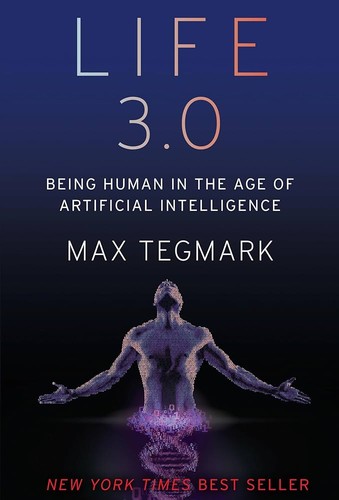
Talk to Life 3.0: Being Human in the Age of Artificial Intelligence like its author wrote you back.
Get the ideas that fit your life — not generic summaries.
- Chat with the book
- Audiobook-style main ideas
- Adapts to your life and goals
- Helps you take action
Key takeaways
- 1.
Life 3.0 can redesign both its hardware and software, escaping biological constraints — which is why the transition from current AI to human-level AI would be qualitatively different from previous technological shifts.
- 2.
The value alignment problem is the central technical challenge: ensuring that an AI system with general capabilities pursues goals that are good for humanity, not just formally consistent with its specification.
- 3.
Artificial intelligence will transform the economy in ways that may not distribute benefits broadly by default; policy decisions about how to manage that transition will matter as much as the technology itself.
- 4.
Autonomous weapons — systems that can select and engage targets without human authorization — raise profound questions about accountability, escalation risk, and the laws of war that international institutions have not yet resolved.
- 5.
The long-term outcome of advanced AI depends heavily on who develops it, under what incentive structures, and whether safety research is prioritized or treated as an obstacle to deployment.
- 6.
Consciousness may be a property of information processing rather than of biological substrate, which makes questions about machine consciousness scientifically meaningful rather than merely philosophical.
- 7.
The range of possible futures from advanced AI runs from extremely good (abundance, health, scientific acceleration) to extremely bad (extinction, permanent lock-in of a narrow set of values), which is why the choices made now matter so much.
- 8.
International coordination on AI development — analogous to nuclear non-proliferation or the Chemical Weapons Convention — may be both necessary and extremely difficult to achieve given competitive pressures.
Discussion questions
Use these on your own, with a book club, or as chat starters in Superbook. Book club version, ready to copy or print →
- 1.
Tegmark's Life 1.0 / 2.0 / 3.0 taxonomy is a frame for thinking about AI. Is it a useful frame, and does it obscure anything important?
- 2.
The fictional prologue depicts a company that develops AGI secretly. Is that scenario realistic, and what should the response be if it happened?
- 3.
How does the AI risk question compare to other large-scale risks — climate change, nuclear weapons, pandemics — in terms of how tractable it is and how urgently it should be addressed?
- 4.
Tegmark argues that consciousness is a property of information processing. Does that seem right? What would follow if it were true?
- 5.
The book distinguishes narrow AI (current systems) from AGI (human-level general intelligence). How confident are you that that distinction is well-defined?
- 6.
He presents economic disruption from AI as a near-term concern separate from the existential risk questions. Which concerns you more, and why?
- 7.
What is your reaction to the range of scenarios Tegmark presents — from utopian to catastrophic? Do you find the full range plausible, or do some scenarios seem far-fetched?
- 8.
Autonomous weapons are already being developed by multiple countries. What international frameworks might govern them, and how realistic is it to negotiate them?
- 9.
Tegmark cofounded the Future of Life Institute and is an insider to the AI safety community. Does that context affect how you read his presentation of the issues?
- 10.
He argues that what matters is who develops advanced AI and under what incentive structures. Do you think those decisions are made by governments, companies, or researchers?
- 11.
How does Life 3.0 compare to Bostrom's Superintelligence in its conclusions and its tone?
- 12.
If you could change one thing about current AI development practices based on reading this book, what would it be?
Themes
Frequently asked questions
-
Is Life 3.0 more accessible than Superintelligence?
Yes, considerably. Tegmark writes for general readers and avoids the formal philosophical analysis style of Bostrom. The fictional prologue and scenario-based approach make the abstract ideas more concrete. Readers new to AI risk will find Life 3.0 a better entry point.
-
What is the Future of Life Institute?
A nonprofit founded by Tegmark and others in 2014 to work on reducing existential risks from transformative technologies, particularly AI and nuclear weapons. It organized the open letter in 2015 signed by thousands of researchers on AI research priorities, and the 2023 open letter calling for a pause in advanced AI development.
-
Does the book take a clear position on whether AI is dangerous?
It takes seriously the full range of outcomes — from very good to very bad — without committing to a specific probability for each. Tegmark believes the outcome is highly uncertain and depends on choices made now, which is why he frames the book as a call to action rather than a prediction.
-
How has the AI landscape changed since 2017?
Substantially. The book was written before the transformer architecture dominated AI, before GPT, and before the public demonstrations of large language models. The economic disruption sections are already partially obsolete. The existential risk arguments remain relevant but the timeline discussions feel dated.
-
What is the 'AI safety' research field?
A research field focused on ensuring that advanced AI systems behave in ways that are beneficial and safe, particularly as they become more capable. It includes technical work on value alignment, interpretability, and robustness, as well as policy and governance work. Tegmark and Bostrom were among the early advocates for taking this field seriously.
Similar books
Superintelligence: Paths, Dangers, Strategies
Nick Bostrom
Human Compatible: Artificial Intelligence and the Problem of Control
Stuart Russell
The Emperor's New Mind
Roger Penrose
Our Mathematical Universe
Max Tegmark
