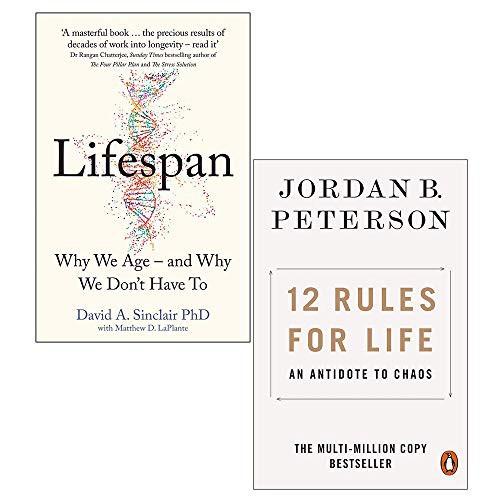
Talk to Lifespan: Why We Age—and Why We Don't Have To like its author wrote you back.
Get the ideas that fit your life — not generic summaries.
- Chat with the book
- Audiobook-style main ideas
- Adapts to your life and goals
- Helps you take action
What it argues
Lifespan opens with a bold claim: aging is not an inevitable feature of biology but a disease — one that can be treated, slowed, and possibly reversed. David Sinclair, a Harvard geneticist who has spent three decades studying why organisms age, builds his argument around what he calls the Information Theory of Aging. Cells contain two kinds of information: digital (the DNA sequence, which stays largely stable across a lifetime) and analog (the epigenome, the chemical layer that tells genes when and where to switch on). Sinclair argues that aging is primarily a loss of epigenetic information — a degradation in the cell's ability to read its own instructions correctly — rather than the accumulation of genetic mutations most people assume it to be.
The book's scientific core traces a set of proteins called sirtuins, which Sinclair helped discover in yeast in the 1990s. Sirtuins act as a kind of cellular maintenance crew, repairing DNA damage and resetting epigenetic marks. Their activity depends heavily on NAD+, a molecule that declines with age. From here, Sinclair walks through the interventions that appear to activate these pathways: caloric restriction and intermittent fasting (both trigger a cellular stress response that ramps up sirtuin activity), exercise, cold exposure, and compounds like resveratrol, metformin, and NMN — molecules Sinclair takes himself and discusses with notable candor. He is careful to distinguish between what the animal data supports and what is proven in humans, though critics argue he sometimes blurs that line.
What it gets right
- 1.
Aging is not biologically inevitable. Sinclair frames it as a disease caused primarily by the loss of epigenetic information — the cell's ability to read its own DNA correctly — rather than by mutations accumulating in the genome itself.
- 2.
Sirtuins are a family of proteins that act as cellular stress responders and epigenetic regulators. Their activity declines with age but can be boosted by the same signals that activate survival circuits: fasting, exercise, and cold.
- 3.
NAD+ is a molecule that sirtuins require to function. Levels fall roughly 50% by middle age. Precursors like NMN and NR can raise NAD+ in animal models; human data is promising but still limited.
What it covers
Who wrote it
David A. Sinclair is a professor of genetics at Harvard Medical School and co-director of the Paul F. Glenn Center for Biology of Aging Research. He earned his PhD from the University of New South Wales and completed postdoctoral training at MIT under Leonard Guarente, where he helped identify the role of sirtuins in aging. Sinclair has published more than 170 peer-reviewed papers and has been named to Time magazine's list of the 100 most influential people in the world. His research focuses on NAD+ metabolism, epigenetic reprogramming, and the biology of longevity. He is also a co-founder of several biotech companies working on age-related disease.
