Talk to Limitless like its author wrote you back.
Get the ideas that fit your life — not generic summaries.
- Chat with the book
- Audiobook-style main ideas
- Adapts to your life and goals
- Helps you take action
Limitless, in detail
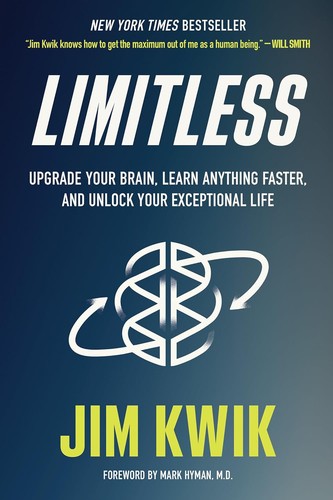
Limitless is Jim Kwik's account of how he overcame a childhood brain injury and learning difficulties to become a professional memory coach and reading accelerator, and what he learned about cognition along the way. The book is structured around three overlapping elements he calls mindset, motivation, and method — arguing that most learning problems trace back to limiting beliefs, unclear purpose, or missing technique, and that changing any one of them changes outcomes.
The mindset section tackles what Kwik calls "LIEs" — Limited Ideas Entertained — the beliefs people hold about their own intelligence and learning capacity. He argues that most adults carry fixed beliefs about their aptitude from early school experiences and that those beliefs function as self-fulfilling constraints. The motivation section focuses on purpose and emotion as accelerants: Kwik argues that learning tied to a clear "why" and an emotional stake encodes faster and retains longer, a claim consistent with memory research on the effect of emotional salience.
The method section is the book's most practical portion. Kwik covers speed reading, active recall, the FASTER learning framework, and a series of memory techniques including name and face associations, the memory palace method, and number-shape mnemonics. The techniques are real and usable, drawn from the broader memory-sport tradition. Kwik's contribution is packaging them accessibly with consistent emphasis on the practice required to make them work.
The book's limitations are worth noting. Kwik's personal story is compelling but leans heavily on his own transformation as evidence, and not all the neuroscience framing is as rigorous as it sounds. Some claims about "brain performance" are overstated in ways that will frustrate readers with a background in cognitive science. But for readers who have always assumed they were bad at memorizing, reading quickly, or learning new skills, Limitless does what it sets out to do: argue that those assumptions are negotiable, and offer specific techniques to test the claim.
The big ideas
- 1.
Most learning limitations are beliefs, not facts. Kwik calls these 'LIEs' — Limited Ideas Entertained — and argues they are usually formed in early educational experiences and then carried unexamined into adult life.
- 2.
Motivation accelerates learning. Knowing clearly why you need to learn something, and connecting it to something that matters, makes encoding faster and retention longer.
- 3.
Speed reading is a trainable skill, not a genetic gift. The key bottleneck is subvocalization — reading the words in your head as you read — and there are techniques to reduce it without sacrificing comprehension.
