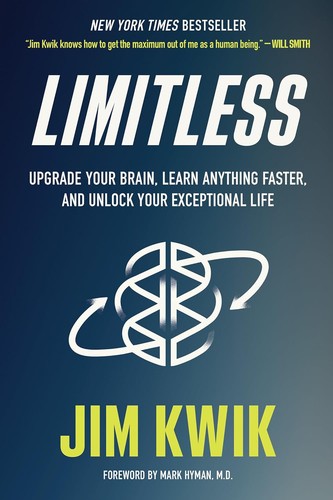
Limitless by Jim Kwik is a 2020 self-help book about learning, memory, brain performance. Most learning limitations are beliefs, not facts. Kwik calls these 'LIEs' — Limited Ideas Entertained — and argues they are usually formed in early educational experiences and then carried unexamined into adult life.
Summary
Limitless is Jim Kwik's account of how he overcame a childhood brain injury and learning difficulties to become a professional memory coach and reading accelerator, and what he learned about cognition along the way. The book is structured around three overlapping elements he calls mindset, motivation, and method — arguing that most learning problems trace back to limiting beliefs, unclear purpose, or missing technique, and that changing any one of them changes outcomes.
The mindset section tackles what Kwik calls "LIEs" — Limited Ideas Entertained — the beliefs people hold about their own intelligence and learning capacity. He argues that most adults carry fixed beliefs about their aptitude from early school experiences and that those beliefs function as self-fulfilling constraints. The motivation section focuses on purpose and emotion as accelerants: Kwik argues that learning tied to a clear "why" and an emotional stake encodes faster and retains longer, a claim consistent with memory research on the effect of emotional salience.
The method section is the book's most practical portion. Kwik covers speed reading, active recall, the FASTER learning framework, and a series of memory techniques including name and face associations, the memory palace method, and number-shape mnemonics. The techniques are real and usable, drawn from the broader memory-sport tradition. Kwik's contribution is packaging them accessibly with consistent emphasis on the practice required to make them work.
The book's limitations are worth noting. Kwik's personal story is compelling but leans heavily on his own transformation as evidence, and not all the neuroscience framing is as rigorous as it sounds. Some claims about "brain performance" are overstated in ways that will frustrate readers with a background in cognitive science. But for readers who have always assumed they were bad at memorizing, reading quickly, or learning new skills, Limitless does what it sets out to do: argue that those assumptions are negotiable, and offer specific techniques to test the claim.
Talk to Limitless like its author wrote you back.
Get the ideas that fit your life — not generic summaries.
- Chat with the book
- Audiobook-style main ideas
- Adapts to your life and goals
- Helps you take action
Key takeaways
- 1.
Most learning limitations are beliefs, not facts. Kwik calls these 'LIEs' — Limited Ideas Entertained — and argues they are usually formed in early educational experiences and then carried unexamined into adult life.
- 2.
Motivation accelerates learning. Knowing clearly why you need to learn something, and connecting it to something that matters, makes encoding faster and retention longer.
- 3.
Speed reading is a trainable skill, not a genetic gift. The key bottleneck is subvocalization — reading the words in your head as you read — and there are techniques to reduce it without sacrificing comprehension.
- 4.
Active recall beats passive review. Re-reading notes is far less effective than closing the book and reconstructing what you know from memory, even if imperfectly.
- 5.
Memory techniques like the memory palace, association, and visualization are not tricks for savants — they are standard tools used by memory champions, and they work for ordinary people who practice them.
- 6.
Forget to learn: Kwik's FASTER framework starts with deliberately forgetting what you think you know so you approach new material with genuine curiosity rather than confirmation bias.
- 7.
What you do immediately after learning — sleep, exercise, or cognitive work — affects how much you retain. The post-learning period is not passive.
- 8.
Nutrition and physical health have real, measurable effects on cognitive function. Kwik covers brain-supportive habits including sleep, exercise, diet, and hydration that most readers already know but don't consistently prioritize.
Discussion questions
Use these on your own, with a book club, or as chat starters in Superbook. Book club version, ready to copy or print →
- 1.
What limiting belief about your own learning capacity have you carried the longest? Where did it come from, and have you ever tested whether it's actually true?
- 2.
Kwik argues that knowing your 'why' makes learning faster. When has having a clear, personal reason to learn something made the process noticeably easier?
- 3.
Have you ever deliberately used a memory technique — a mnemonic, a visualization, a story — to remember something? Did it work, and did you keep using it?
- 4.
What is one skill you've been putting off learning because you assume you're not good at it? What would you try if you assumed the constraint was a belief rather than a fact?
- 5.
Speed reading claims range from well-supported to pseudoscientific. What's your experience with reading speed, and what do you think the real bottlenecks are?
- 6.
Active recall is one of the most well-supported findings in learning science. How does it compare to how you actually study or learn new material?
- 7.
What does your post-learning behavior look like? Do you sleep, exercise, or go straight back to cognitively demanding work?
- 8.
Kwik emphasizes that he built his memory skills after a significant disadvantage. Does his personal story make the techniques feel more or less credible to you?
- 9.
Where in your professional life are you regularly expected to learn and retain new material? Which of Kwik's methods seems most directly applicable there?
- 10.
The book covers both mindset and practical technique. Which do you think is the bigger limiting factor for most adults — their beliefs or their methods?
- 11.
Kwik recommends teaching what you learn to someone else as a powerful retention tool. When have you experienced the effect of explaining something and discovering what you didn't actually understand?
- 12.
What is the most important thing you've wanted to memorize or learn in the last year that you haven't made real progress on? What got in the way?
Themes
Frequently asked questions
-
Is Limitless worth reading?
It depends on what you're looking for. If you want practical memory and learning techniques delivered with enthusiasm, it's accessible and useful. If you want rigorous neuroscience, some claims will frustrate you. The techniques in the method section are legitimate regardless of how the science framing holds up.
-
How long does it take to read Limitless?
Around five hours at average reading pace. The book is 320 pages. Kwik includes exercises throughout, and readers who complete them spend additional time. Some chapters are dense with techniques and reward re-reading once you've tried them.
-
What is the most useful idea in Limitless?
Active recall over passive review. It's the most consistently supported finding in memory science, and it contradicts how most people actually study. Kwik's framing around it is accessible and practical, even for readers skeptical of other parts of the book.
-
Are the speed reading claims in Limitless credible?
Partially. The research supports the idea that reading speed can be improved and that subvocalization is a common bottleneck. The very high speed claims in the memory sport world involve significant trade-offs in comprehension. Kwik's recommendations for practical improvement are more modest and more defensible.
-
Who should read Limitless?
Adults who feel stuck in how they learn and want specific techniques to try. Students, professionals taking on new skills, and anyone who has written themselves off as bad at memorizing, reading quickly, or retaining information will find it directly applicable.