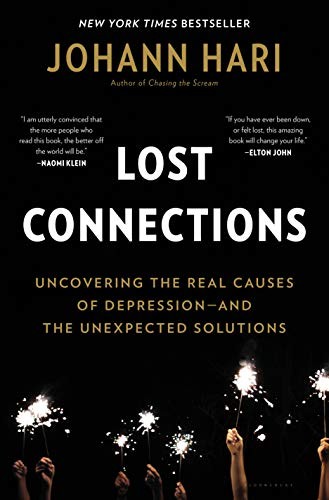
Talk to Lost Connections like its author wrote you back.
Get the ideas that fit your life — not generic summaries.
- Chat with the book
- Audiobook-style main ideas
- Adapts to your life and goals
- Helps you take action
Lost Connections, in detail
Lost Connections is Johann Hari's argument that depression and anxiety are not primarily chemical imbalances in the brain but responses to social and environmental conditions — disconnection from meaningful work, close relationships, the natural world, a secure future, and status that feels deserved. Hari is a journalist who spent years on antidepressants, eventually discovered they were not working as described, and investigated the science of depression thoroughly enough to write a provocative counter-narrative to the dominant biomedical model.
The book begins with a critique of the chemical imbalance theory of depression — the idea that depression is caused by low serotonin and corrected by SSRIs. Hari argues, with support from researchers including Irving Kirsch (who published analyses showing antidepressants perform only marginally better than placebo in most patients), that the serotonin hypothesis was never well-established and became entrenched through pharmaceutical marketing rather than solid science. He is careful to note that antidepressants help some people and that he is not recommending anyone stop taking them without medical guidance.
The constructive half of the book identifies nine causes of depression and anxiety that Hari argues are primary — disconnection from meaningful work, other people, meaningful values, childhood trauma, status, the natural world, a hopeful or secure future, and lack of real social belonging. He interviews researchers working on each of these fronts, building a case that depression is largely a signal that something in the person's life needs to change, and that treating it solely as a brain chemistry problem is both scientifically dubious and practically insufficient.
Hari's proposed solutions are collective rather than individual. He covers the evidence on meaningful work, on social prescribing (connecting people to community activities as mental health treatment), on the therapeutic effects of nature, and on economic insecurity as a driver of depression at the population level. The book is more compelling in its diagnosis than its prescription, and Hari is honest that collective solutions to social problems are politically difficult. Lost Connections has been influential and controversial — critics have challenged specific claims about antidepressant efficacy, and some mental health professionals object to what they see as an oversimplification. But the core argument — that depression has social causes and requires social solutions alongside biological ones — represents genuine scientific consensus that popular mental health culture has not yet fully absorbed.
The big ideas
- 1.
The chemical imbalance theory of depression — that low serotonin causes depression and SSRIs correct it — was never well-established and has been progressively undermined by research, including meta-analyses showing antidepressants' effect is primarily placebo in mild to moderate cases.
- 2.
Depression and anxiety are often signals that something meaningful is missing from a person's life — responses to real conditions rather than malfunctions of a brain that would otherwise be fine.
- 3.
Disconnection from meaningful work is one of the most powerful predictors of depression in modern populations; precarious, meaningless, or controlled work is a mental health risk factor.
