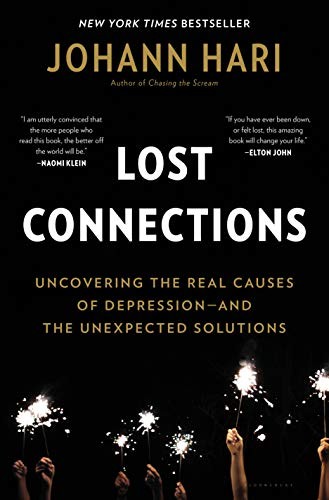
Lost Connections by Johann Hari is a 2018 health book about depression, social connection, mental health. The chemical imbalance theory of depression — that low serotonin causes depression and SSRIs correct it — was never well-established and has been progressively undermined by research, including meta-analyses showing antidepressants' effect is primarily placebo in mild to moderate cases.
Summary
Lost Connections is Johann Hari's argument that depression and anxiety are not primarily chemical imbalances in the brain but responses to social and environmental conditions — disconnection from meaningful work, close relationships, the natural world, a secure future, and status that feels deserved. Hari is a journalist who spent years on antidepressants, eventually discovered they were not working as described, and investigated the science of depression thoroughly enough to write a provocative counter-narrative to the dominant biomedical model.
The book begins with a critique of the chemical imbalance theory of depression — the idea that depression is caused by low serotonin and corrected by SSRIs. Hari argues, with support from researchers including Irving Kirsch (who published analyses showing antidepressants perform only marginally better than placebo in most patients), that the serotonin hypothesis was never well-established and became entrenched through pharmaceutical marketing rather than solid science. He is careful to note that antidepressants help some people and that he is not recommending anyone stop taking them without medical guidance.
The constructive half of the book identifies nine causes of depression and anxiety that Hari argues are primary — disconnection from meaningful work, other people, meaningful values, childhood trauma, status, the natural world, a hopeful or secure future, and lack of real social belonging. He interviews researchers working on each of these fronts, building a case that depression is largely a signal that something in the person's life needs to change, and that treating it solely as a brain chemistry problem is both scientifically dubious and practically insufficient.
Hari's proposed solutions are collective rather than individual. He covers the evidence on meaningful work, on social prescribing (connecting people to community activities as mental health treatment), on the therapeutic effects of nature, and on economic insecurity as a driver of depression at the population level. The book is more compelling in its diagnosis than its prescription, and Hari is honest that collective solutions to social problems are politically difficult. Lost Connections has been influential and controversial — critics have challenged specific claims about antidepressant efficacy, and some mental health professionals object to what they see as an oversimplification. But the core argument — that depression has social causes and requires social solutions alongside biological ones — represents genuine scientific consensus that popular mental health culture has not yet fully absorbed.
Talk to Lost Connections like its author wrote you back.
Get the ideas that fit your life — not generic summaries.
- Chat with the book
- Audiobook-style main ideas
- Adapts to your life and goals
- Helps you take action
Key takeaways
- 1.
The chemical imbalance theory of depression — that low serotonin causes depression and SSRIs correct it — was never well-established and has been progressively undermined by research, including meta-analyses showing antidepressants' effect is primarily placebo in mild to moderate cases.
- 2.
Depression and anxiety are often signals that something meaningful is missing from a person's life — responses to real conditions rather than malfunctions of a brain that would otherwise be fine.
- 3.
Disconnection from meaningful work is one of the most powerful predictors of depression in modern populations; precarious, meaningless, or controlled work is a mental health risk factor.
- 4.
Social isolation and loneliness are as predictive of mortality as smoking fifteen cigarettes a day — the epidemic of social disconnection is a public health crisis of the same magnitude as physical epidemics.
- 5.
Childhood trauma is one of the strongest predictors of adult depression; unacknowledged or untreated early trauma is frequently the root cause of depression that continues to be treated with medication alone.
- 6.
The natural world has measurable effects on mental health; time in nature reduces cortisol, rumination, and depression markers in ways that are robust and dose-responsive.
- 7.
Status insecurity in highly unequal societies is a chronic stressor; depression rates are higher in more unequal countries after controlling for overall wealth.
- 8.
Collective solutions to depression — meaningful work, strong communities, reduced economic insecurity, social prescribing — are more durable than individual medication for the structural causes the book identifies.
Discussion questions
Use these on your own, with a book club, or as chat starters in Superbook. Book club version, ready to copy or print →
- 1.
Hari argues that antidepressants have been oversold and their efficacy overstated. How does that change how you think about the role of medication in treating depression?
- 2.
He identifies nine social causes of depression. Which of the nine do you think is most underrecognized in public mental health conversations? Which feels most present in your own life?
- 3.
The book argues that depression is often a signal that something needs to change rather than a malfunction to be suppressed. Is that reframing empowering or does it risk adding guilt to an already painful condition?
- 4.
Hari is a journalist making an argument, not a clinician or researcher. How does that affect your confidence in his synthesis of the evidence?
- 5.
He covers social prescribing — doctors prescribing community activities rather than or alongside medication. Does that model seem viable in the healthcare systems you're familiar with?
- 6.
The book argues that economic insecurity and work conditions drive depression at the population level. Does mental health conversation in your experience address those structural determinants?
- 7.
Hari writes from personal experience with depression and antidepressants. Does that personal stake make the book more or less trustworthy as an account of the science?
- 8.
He covers the natural world's effects on mental health. How much time do you spend in nature, and does the evidence about its effects make you want to prioritize it differently?
- 9.
The critics of the book argue that Hari is too dismissive of antidepressants and that his account of the serotonin theory is a strawman. How do you evaluate that critique?
- 10.
Lost Connections calls for collective responses to what it frames as collective problems. Is that politically realistic, or does it shift responsibility away from individuals in ways that don't help people struggling now?
- 11.
Which of the reconnections Hari proposes — to people, to meaningful work, to the natural world, to a hopeful future — seems most achievable for you right now?
- 12.
The book covers how strong social bonds protect against depression even in adverse circumstances. What would strengthening your own social connections actually require?
Themes
Frequently asked questions
-
Is Lost Connections anti-psychiatry?
Not exactly. Hari does not argue against all psychiatric medication or that antidepressants never help — he takes antidepressants himself for much of the book's story. His argument is that the chemical imbalance model is scientifically overstated, that antidepressants are overprescribed for conditions with primarily social causes, and that individual medication is insufficient without addressing those causes.
-
Is the science in Lost Connections reliable?
The book draws on real research but has been criticized for selective citation and for presenting contested findings with more certainty than the evidence warrants. The core argument — that depression has social determinants and that antidepressant efficacy has been overstated — is supported by genuine researchers. Some specific claims are more contested. Read it alongside responses from psychiatrists and psychologists.
-
Does Lost Connections recommend stopping antidepressants?
Explicitly no. Hari includes a note saying that stopping antidepressants abruptly is dangerous and that readers should consult their doctor. The book argues for addressing the social causes of depression alongside medication, not against medication per se.
-
Who should read Lost Connections?
People who have been on antidepressants without feeling fundamentally better and want to understand the other determinants of their mental health. People experiencing depression or anxiety who want a broader framework than the biological model. People interested in the sociology of mental health. Not a substitute for clinical care.
-
What is the most practically actionable idea in Lost Connections?
Social reconnection — rebuilding genuine relationships and community involvement — has the strongest evidence base among the social prescriptions Hari covers. His chapter on meaningful work and the Cambodian village example (where villagers recovered from PTSD through economic inclusion and community activity) are the most vivid illustrations of his argument.