Talk to Make It Stick like its author wrote you back.
Get the ideas that fit your life — not generic summaries.
- Chat with the book
- Audiobook-style main ideas
- Adapts to your life and goals
- Helps you take action
Make It Stick, in detail
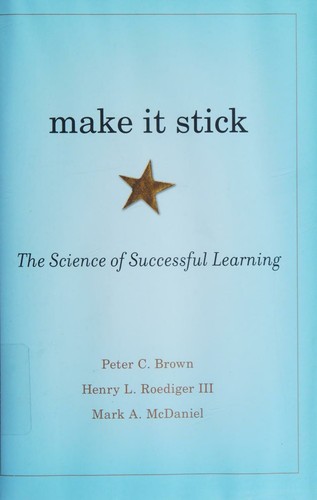
Make It Stick is a book about how memory actually works, and why the study techniques most people rely on — re-reading, highlighting, massed practice — are among the least effective ways to learn. Written by two cognitive scientists and a writer, it draws on decades of research to argue that learning feels hardest precisely when it is sticking most deeply, and that the ease of re-reading is a false signal of mastery.
The central insight is that retrieval practice — testing yourself rather than restudying — is the most powerful tool available. Every time you pull information out of memory, you strengthen the neural pathways that hold it. The harder the retrieval, the more durable the memory. This is why flashcards, practice tests, and free recall outperform passive review by a wide margin. The book also covers interleaving: mixing different problems or subjects in a single session rather than drilling one thing at a time. Interleaving feels disorganizing and slow, but it produces better long-term retention and the ability to discriminate between types of problems — a skill that massed practice never builds.
Spaced practice is the third pillar: returning to material after a delay, when forgetting has begun. The act of re-learning from partial forgetting is more durable than studying the same thing repeatedly in one sitting. The authors also cover elaborative interrogation (asking why and how, connecting new material to what you already know), generation (trying to solve a problem before seeing the answer), and interleaving these techniques throughout a learning schedule.
The book ends with practical guidance for students, teachers, and trainers. It addresses a core frustration: effective study feels harder, slower, and less satisfying than passive review. Students who interleave and self-test often feel like they are performing worse even when they are learning more. Trusting the science means overriding the feeling that easy is good.
The big ideas
- 1.
Retrieval practice — recalling information rather than re-reading it — is the single most effective way to move learning into long-term memory.
- 2.
The feeling of fluency during re-reading is a false signal. If something feels effortless to review, it may not be sticking.
- 3.
Interleaving different subjects or problem types in a single session feels disorganizing but produces better long-term performance and the ability to transfer skills.
