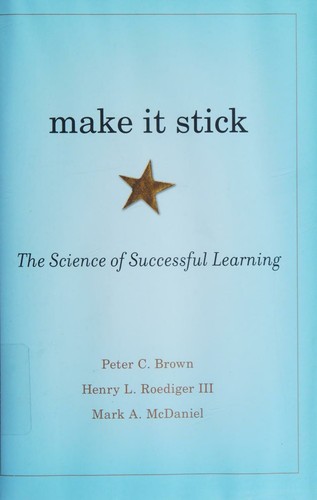
Make It Stick by Peter C. Brown, Henry L. Roediger and Mark A. McDaniel is a 2014 science book about learning, memory, cognitive science. Retrieval practice — recalling information rather than re-reading it — is the single most effective way to move learning into long-term memory.
Summary
Make It Stick is a book about how memory actually works, and why the study techniques most people rely on — re-reading, highlighting, massed practice — are among the least effective ways to learn. Written by two cognitive scientists and a writer, it draws on decades of research to argue that learning feels hardest precisely when it is sticking most deeply, and that the ease of re-reading is a false signal of mastery.
The central insight is that retrieval practice — testing yourself rather than restudying — is the most powerful tool available. Every time you pull information out of memory, you strengthen the neural pathways that hold it. The harder the retrieval, the more durable the memory. This is why flashcards, practice tests, and free recall outperform passive review by a wide margin. The book also covers interleaving: mixing different problems or subjects in a single session rather than drilling one thing at a time. Interleaving feels disorganizing and slow, but it produces better long-term retention and the ability to discriminate between types of problems — a skill that massed practice never builds.
Spaced practice is the third pillar: returning to material after a delay, when forgetting has begun. The act of re-learning from partial forgetting is more durable than studying the same thing repeatedly in one sitting. The authors also cover elaborative interrogation (asking why and how, connecting new material to what you already know), generation (trying to solve a problem before seeing the answer), and interleaving these techniques throughout a learning schedule.
The book ends with practical guidance for students, teachers, and trainers. It addresses a core frustration: effective study feels harder, slower, and less satisfying than passive review. Students who interleave and self-test often feel like they are performing worse even when they are learning more. Trusting the science means overriding the feeling that easy is good.
Talk to Make It Stick like its author wrote you back.
Get the ideas that fit your life — not generic summaries.
- Chat with the book
- Audiobook-style main ideas
- Adapts to your life and goals
- Helps you take action
Key takeaways
- 1.
Retrieval practice — recalling information rather than re-reading it — is the single most effective way to move learning into long-term memory.
- 2.
The feeling of fluency during re-reading is a false signal. If something feels effortless to review, it may not be sticking.
- 3.
Interleaving different subjects or problem types in a single session feels disorganizing but produces better long-term performance and the ability to transfer skills.
- 4.
Spaced practice — studying in sessions separated by time, after forgetting has begun — produces more durable learning than massed cramming.
- 5.
Desirable difficulty is the principle that makes effective study feel counterproductive: the harder the retrieval, the more the memory consolidates.
- 6.
Elaboration — connecting new material to what you already know by asking why and how — anchors it more deeply than passive absorption.
- 7.
Generation: trying to solve or recall before seeing the answer, even when you get it wrong, primes the brain to encode the correct information more strongly.
- 8.
Students and teachers both systematically prefer the study techniques that feel best but work least. Awareness of this bias is the first step to working around it.
Discussion questions
Use these on your own, with a book club, or as chat starters in Superbook. Book club version, ready to copy or print →
- 1.
The book argues that how learning feels and how much it sticks are often inversely related. Where in your own experience have you found this to be true?
- 2.
Which of your current study or learning habits most closely resemble re-reading — comfortable but ineffective? What would a retrieval-practice version look like?
- 3.
Interleaving feels disorganizing. Have you ever experienced a domain where mixing problem types actually helped you perform better?
- 4.
The authors argue that most teachers and trainers design instruction to feel smooth and comfortable rather than to produce retention. What would a classroom designed around desirable difficulty look like?
- 5.
When was the last time you tested yourself on something you thought you understood, and discovered you had less of it than you believed?
- 6.
How do you distinguish genuine mastery from the feeling of fluency that comes from repeated exposure to the same material?
- 7.
If you had to design a spaced repetition schedule for the most important thing you need to learn right now, what would it look like?
- 8.
The book mentions that students who interleave and self-test often feel like they are learning more slowly. How would you counsel a student who reports this experience?
- 9.
Elaborative interrogation asks you to explain why something is true, not just what it is. Pick a topic you think you know well. Can you explain the why?
- 10.
Does knowing that your preferred study method is ineffective actually change how you study? What makes it hard to switch even with the evidence?
- 11.
The research described involves mostly academic settings. Where does it apply cleanly to professional skill development, and where does it break down?
- 12.
What would it mean to redesign a corporate training program — onboarding, compliance, skills — around the principles in this book?
Themes
Frequently asked questions
-
Is Make It Stick worth reading for adults, not just students?
Yes. The research applies equally to professional skill development, language learning, and any domain where long-term retention matters. The book is written for teachers and trainers as much as students, and the principles work regardless of age.
-
How long does it take to read Make It Stick?
Around four to five hours for the 250-page book. The chapters are organized by concept rather than chronologically, so readers can move non-linearly once they have the core framework.
-
What is the main idea of Make It Stick?
That the most effective learning strategies — retrieval practice, spaced practice, interleaving — feel harder and slower than passive review, but produce dramatically better retention and transfer. The book's core argument is that fluency is not mastery.
-
What is retrieval practice and how do you use it?
Retrieval practice means recalling information from memory rather than re-reading it. In practice this means closing your notes and trying to write down what you remember, using flashcards, taking practice tests, or explaining the material to someone else without looking at your source.
-
Who should read Make It Stick?
Students, teachers, coaches, trainers, and anyone who needs to retain complex material over time. It is particularly useful for people in technical fields or professional roles where skill degradation under pressure is a real cost.
Similar books

A Mind for Numbers
Barbara Oakley
Peak: Secrets from the New Science of Expertise
Anders Ericsson and Robert Pool
Ultralearning
Scott Young
Mindset: The New Psychology of Success
Carol S. Dweck
