Talk to Make Time like its author wrote you back.
Get the ideas that fit your life — not generic summaries.
- Chat with the book
- Audiobook-style main ideas
- Adapts to your life and goals
- Helps you take action
Make Time, in detail
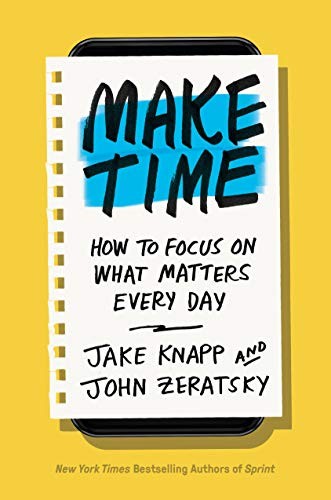
Make Time is a practical guide from two former Google Ventures designers who grew frustrated watching their own attention get swallowed by the default rhythms of the modern workday. Jake Knapp and John Zeratsky argue that the standard advice to improve focus — get up earlier, optimize your calendar, practice more willpower — misses the problem. The real obstacle is the Infinity Pool apps and Busy Bandwagon culture that have colonized modern life, making reactive busyness feel like productivity.
The book's framework rests on a single daily question: what is the one thing you most want to make time for today? They call this the Highlight. It's not necessarily urgent or important in the professional sense — it might be a project, a hobby, or time with family. The Highlight gives the day a center of gravity that resists the pull of the urgent.
The second part is Laser: tactics for protecting time to work on the Highlight without distraction. Knapp and Zeratsky offer eighty-seven specific experiments — removing apps from your phone's home screen, setting a fake deadline, building a distraction-free environment, logging out of email — and invite readers to pick what resonates rather than adopting a prescribed system. The tone throughout is experimentalist: try things, notice what works, discard what doesn't.
The third and fourth parts address Energy and Reflection. Energy tactics keep you physiologically capable of focused work: real food, real sleep, real exercise, real breaks. The reflection step is a short nightly check-in: did I do my Highlight, what worked, what felt off? The emphasis is on iteration rather than optimization. Make Time doesn't promise a permanent system. It offers a framework for designing each day a little more deliberately than the last.
The big ideas
- 1.
The Highlight is the most important move in the framework: picking one meaningful thing you want to accomplish each day before the day's reactive current takes over.
- 2.
Infinity Pools (social media, news feeds, YouTube) are engineered to refill infinitely. The only way to reclaim attention is to remove the default access points, not to rely on willpower.
- 3.
The Busy Bandwagon — the cultural assumption that being constantly available and occupied signals importance — is a trap, not a virtue.
