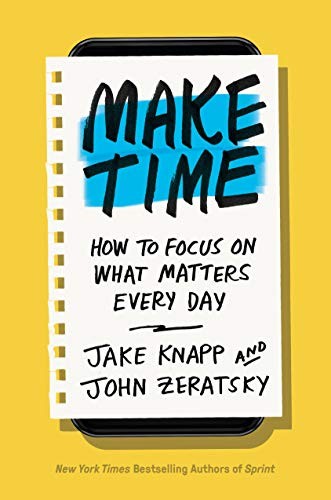
Make Time by Jake Knapp and John Zeratsky is a 2018 self-help book about time management, focus, habits. The Highlight is the most important move in the framework: picking one meaningful thing you want to accomplish each day before the day's reactive current takes over.
Summary
Make Time is a practical guide from two former Google Ventures designers who grew frustrated watching their own attention get swallowed by the default rhythms of the modern workday. Jake Knapp and John Zeratsky argue that the standard advice to improve focus — get up earlier, optimize your calendar, practice more willpower — misses the problem. The real obstacle is the Infinity Pool apps and Busy Bandwagon culture that have colonized modern life, making reactive busyness feel like productivity.
The book's framework rests on a single daily question: what is the one thing you most want to make time for today? They call this the Highlight. It's not necessarily urgent or important in the professional sense — it might be a project, a hobby, or time with family. The Highlight gives the day a center of gravity that resists the pull of the urgent.
The second part is Laser: tactics for protecting time to work on the Highlight without distraction. Knapp and Zeratsky offer eighty-seven specific experiments — removing apps from your phone's home screen, setting a fake deadline, building a distraction-free environment, logging out of email — and invite readers to pick what resonates rather than adopting a prescribed system. The tone throughout is experimentalist: try things, notice what works, discard what doesn't.
The third and fourth parts address Energy and Reflection. Energy tactics keep you physiologically capable of focused work: real food, real sleep, real exercise, real breaks. The reflection step is a short nightly check-in: did I do my Highlight, what worked, what felt off? The emphasis is on iteration rather than optimization. Make Time doesn't promise a permanent system. It offers a framework for designing each day a little more deliberately than the last.
Talk to Make Time like its author wrote you back.
Get the ideas that fit your life — not generic summaries.
- Chat with the book
- Audiobook-style main ideas
- Adapts to your life and goals
- Helps you take action
Key takeaways
- 1.
The Highlight is the most important move in the framework: picking one meaningful thing you want to accomplish each day before the day's reactive current takes over.
- 2.
Infinity Pools (social media, news feeds, YouTube) are engineered to refill infinitely. The only way to reclaim attention is to remove the default access points, not to rely on willpower.
- 3.
The Busy Bandwagon — the cultural assumption that being constantly available and occupied signals importance — is a trap, not a virtue.
- 4.
Laser tactics create distraction-free conditions for the Highlight. Removing apps, blocking websites, and changing your environment are more reliable than trying to resist in the moment.
- 5.
Energy is upstream of focus. Poor sleep, sitting all day, and constant snacking degrade your ability to concentrate more than any app or notification.
- 6.
The nightly reflection is a lightweight feedback loop. A few minutes noting what worked and what didn't compounds into a personalized system over weeks.
- 7.
Tactics are not rules. The eighty-seven experiments in the book are a menu, not a prescription. Trying many and keeping few is the intended approach.
- 8.
Time management as usually practiced tries to do more things faster. Make Time tries to do fewer things that matter more.
Discussion questions
Use these on your own, with a book club, or as chat starters in Superbook. Book club version, ready to copy or print →
- 1.
What would your Highlight be today, and what stopped you from protecting time for it this week?
- 2.
Which Infinity Pool has the strongest pull on your attention? What would it take to remove it from your phone's home screen?
- 3.
Knapp and Zeratsky say the Busy Bandwagon makes busyness feel like virtue. Where in your life do you perform busyness for an audience?
- 4.
The book offers eighty-seven tactics. Which three feel most immediately actionable in your current setup? Which three feel unrealistic right now?
- 5.
How does your current morning routine shape what you end up spending your first hour on? Is that what you'd choose?
- 6.
The authors frame the nightly reflection as a two-minute check-in. What would you need to believe about your evenings to actually do that?
- 7.
Think of the last week you felt genuinely satisfied at the end of each day. What conditions made that possible?
- 8.
The book deprioritizes goals in favor of daily design. Do you find that freeing or unsettling? Why?
- 9.
Which energy tactic — sleep, movement, food, or real breaks — is most neglected in your week? What would a one-week experiment look like?
- 10.
Knapp designed Google Ventures' sprint methodology. How does the Make Time framework compare to sprints as a way of protecting focused work?
- 11.
The authors removed social media from their phones but kept it on laptops. Where would you draw your own line?
- 12.
If a version of you from five years ago looked at how you spend your attention today, what would surprise them most?
Themes
Frequently asked questions
-
Is Make Time worth reading?
Yes, especially if you've tried productivity systems and found them too rigid or too demanding to sustain. The book's strength is its experimental attitude: it offers a simple daily framework and a large menu of tactics, encouraging you to pick what works rather than adopt a complete system.
-
How long does it take to read Make Time?
About four hours at average pace. The chapters are short — most are a page or two — and the book is designed to be skimmed and dipped into rather than read linearly. Many readers finish the core framework in an hour and spend the rest of the time browsing tactics.
-
What is the main idea of Make Time?
Pick one meaningful thing each day (the Highlight), protect time for it using specific tactics, manage your energy, and reflect briefly each evening. Repeat, adjusting as you learn. The goal is not maximum efficiency but a day that felt intentional.
-
Who should read Make Time?
Knowledge workers who feel like their days are reactive rather than directed. Also useful for anyone who ends each day feeling busy but not satisfied with what they actually spent time on.
-
What's the most actionable idea in Make Time?
Removing social media and news apps from your phone's home screen — not deleting them, just making them harder to reach reflexively. This single environmental change breaks the most common attention-hijacking pattern without requiring sustained willpower.
Similar books
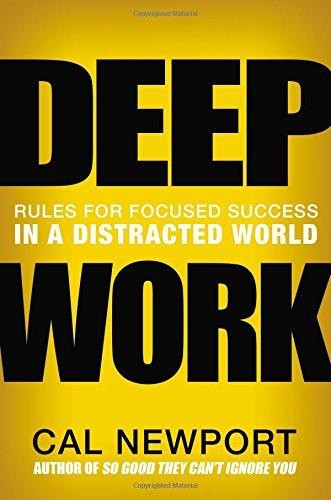
Deep Work
Cal Newport
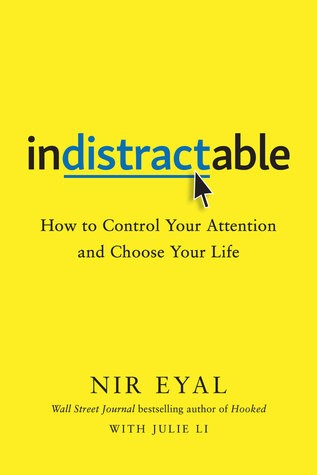
Indistractable: How to Control Your Attention and Choose Your Life
Nir Eyal
Essentialism: The Disciplined Pursuit of Less
Greg McKeown
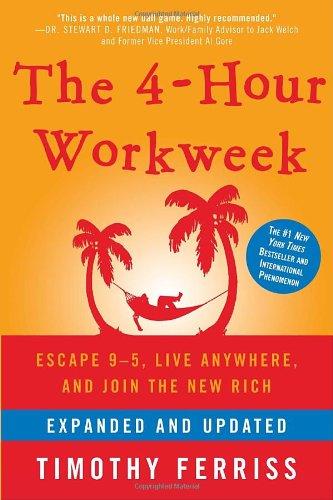
The 4-Hour Workweek
Timothy Ferriss
