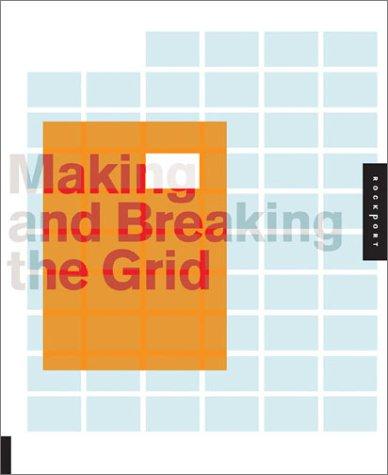
Talk to Making and Breaking the Grid like its author wrote you back.
Get the ideas that fit your life — not generic summaries.
- Chat with the book
- Audiobook-style main ideas
- Adapts to your life and goals
- Helps you take action
Making and Breaking the Grid, in detail
Making and Breaking the Grid is a textbook for graphic designers that does something most design textbooks avoid: it teaches both halves of its title with equal seriousness. The first half explains how grid systems work — their history, their structural logic, the variety of grid types (manuscript, column, modular, hierarchical), and the specific decisions that go into building one for a project. The second half examines how designers break grids deliberately and effectively, arguing that rule-breaking is only meaningful when the rule is understood first.
Timothy Samara's historical account of the grid begins in medieval manuscript layout and moves through the Swiss International Style of the 1950s and 1960s — the period when grid-based design reached its most systematic expression in the work of Josef Müller-Brockmann and his contemporaries. The International Style treated the grid as a structural and moral commitment: not just an organizational tool but an argument about rationality, universality, and the proper relationship between form and content. Samara presents this history clearly without being hagiographic about it.
The practical sections are the book's strongest contribution. Samara takes readers through the construction of multiple grid types, showing how decisions about column width, gutter size, baseline grid, and margin ratios interact and what each choice implies. The examples are drawn from magazines, books, posters, websites, and corporate identities — a range that prevents the book from feeling like it is only about print. The analysis of each example is specific rather than general: Samara says what is happening structurally in a design, not just whether it looks good.
The breaking section is handled with similar rigor. Samara identifies the categories of intentional grid violation — typographic randomness, illustration-driven layouts, data-driven irregularity — and shows examples of each working and not working. His argument is not that rules should be broken but that designers need to understand what they are breaking and why, or the result is noise rather than expression. For students in design programs and for self-taught designers building a structural foundation, the book remains a practical and well-organized resource.
The big ideas
- 1.
A grid is a structural system for organizing visual information, not an aesthetic choice. Understanding how grids create order, hierarchy, and rhythm is foundational to design practice.
- 2.
The Swiss International Style of the 1950s and 1960s treated grid-based design as both a functional and an ethical position — an argument for rationality and universal communication.
- 3.
Column grids, manuscript grids, modular grids, and hierarchical grids each imply different content relationships. Choosing the right structure is a design decision that precedes any formal choices.
