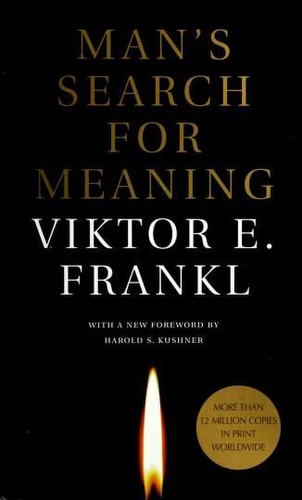
Talk to Man's Search for Meaning like its author wrote you back.
Get the ideas that fit your life — not generic summaries.
- Chat with the book
- Audiobook-style main ideas
- Adapts to your life and goals
- Helps you take action
Man's Search for Meaning, in detail
Man's Search for Meaning is Viktor Frankl's account of his years as a prisoner in Nazi concentration camps, including Auschwitz, and the psychological theory he developed from that experience. The book has two parts: the first is a spare, controlled memoir of camp life; the second introduces logotherapy, Frankl's school of psychotherapy built on the premise that the primary human drive is not pleasure or power but the search for meaning. Together they form one of the few books where the theory and the evidence for it are the same story.
What Frankl observed in the camps was that survival correlated less with physical health than with what a prisoner had to live for. Those who retained a sense of purpose — a manuscript to finish, a person to return to, a task that only they could complete — tended to endure longer and maintain more psychological coherence than those who lost their sense of future. Frankl draws on Nietzsche's line that a person who has a why can bear almost any how. He does not romanticize the camps or suggest that meaning made survival likely. He is clear that chance determined most outcomes. But he argues that meaning determined how people faced their circumstances.
Logotherapy, the theory that emerges from this, holds that meaning can be found through work (creating or accomplishing something), through love (encountering another person or the world), and through suffering (taking a stand toward unavoidable pain). The last is the most demanding idea in the book: that even when everything else is stripped away, a person retains the freedom to choose their attitude toward what happens to them. Frankl calls this the last of the human freedoms. He does not claim it is easy to exercise, only that it is real.
The book is short — around 165 pages in most editions — and written for a general audience, not an academic one. The memoir section is more affecting than the theory section, which can feel compressed and slightly dated in its clinical framing. Frankl wrote it in nine days in 1945, which shows in places. But the core observation — that meaning is not found, it is made, and that it can be made even under the worst conditions — has held up across eight decades and more than 16 million copies sold.
The big ideas
- 1.
The primary human drive is the search for meaning, not pleasure or power. People can endure almost any hardship if they have a reason to endure it.
- 2.
Meaning can be found in three ways: through work (creating or achieving something), through love (connecting with another person or the world), and through suffering (choosing one's attitude toward unavoidable pain).
- 3.
Even in the most extreme circumstances, people retain the freedom to choose how they respond to what happens to them. Frankl calls this the last of the human freedoms.
