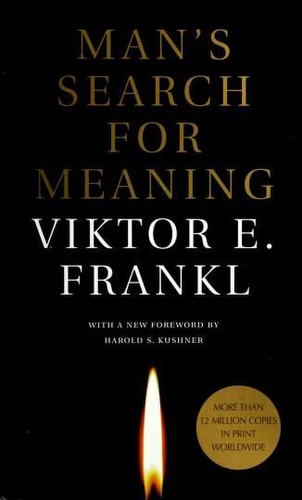
Man's Search for Meaning by Viktor E. Frankl is a 1946 psychology book about meaning, suffering, resilience. The primary human drive is the search for meaning, not pleasure or power. People can endure almost any hardship if they have a reason to endure it.
Summary
Man's Search for Meaning is Viktor Frankl's account of his years as a prisoner in Nazi concentration camps, including Auschwitz, and the psychological theory he developed from that experience. The book has two parts: the first is a spare, controlled memoir of camp life; the second introduces logotherapy, Frankl's school of psychotherapy built on the premise that the primary human drive is not pleasure or power but the search for meaning. Together they form one of the few books where the theory and the evidence for it are the same story.
What Frankl observed in the camps was that survival correlated less with physical health than with what a prisoner had to live for. Those who retained a sense of purpose — a manuscript to finish, a person to return to, a task that only they could complete — tended to endure longer and maintain more psychological coherence than those who lost their sense of future. Frankl draws on Nietzsche's line that a person who has a why can bear almost any how. He does not romanticize the camps or suggest that meaning made survival likely. He is clear that chance determined most outcomes. But he argues that meaning determined how people faced their circumstances.
Logotherapy, the theory that emerges from this, holds that meaning can be found through work (creating or accomplishing something), through love (encountering another person or the world), and through suffering (taking a stand toward unavoidable pain). The last is the most demanding idea in the book: that even when everything else is stripped away, a person retains the freedom to choose their attitude toward what happens to them. Frankl calls this the last of the human freedoms. He does not claim it is easy to exercise, only that it is real.
The book is short — around 165 pages in most editions — and written for a general audience, not an academic one. The memoir section is more affecting than the theory section, which can feel compressed and slightly dated in its clinical framing. Frankl wrote it in nine days in 1945, which shows in places. But the core observation — that meaning is not found, it is made, and that it can be made even under the worst conditions — has held up across eight decades and more than 16 million copies sold.
Talk to Man's Search for Meaning like its author wrote you back.
Get the ideas that fit your life — not generic summaries.
- Chat with the book
- Audiobook-style main ideas
- Adapts to your life and goals
- Helps you take action
Key takeaways
- 1.
The primary human drive is the search for meaning, not pleasure or power. People can endure almost any hardship if they have a reason to endure it.
- 2.
Meaning can be found in three ways: through work (creating or achieving something), through love (connecting with another person or the world), and through suffering (choosing one's attitude toward unavoidable pain).
- 3.
Even in the most extreme circumstances, people retain the freedom to choose how they respond to what happens to them. Frankl calls this the last of the human freedoms.
- 4.
A sense of future purpose — a task to complete, a person waiting — was one of the strongest psychological anchors Frankl observed among survivors in the camps.
- 5.
Suffering is not a prerequisite for meaning, but meaning can be extracted from suffering. This is not optimism but a claim about human agency in the face of loss.
- 6.
Logotherapy treats the lack of meaning — existential vacuum — as a major source of modern depression, aggression, and addiction, not as a symptom of other psychological problems.
- 7.
Frankl argues that meaning cannot be given to someone else; it must be found by the individual through their own engagement with life, work, and relationships.
- 8.
The book is not a self-help manual. Frankl does not promise that searching for meaning will make life easier. He argues it will make it more livable.
Discussion questions
Use these on your own, with a book club, or as chat starters in Superbook. Book club version, ready to copy or print →
- 1.
Frankl says meaning cannot be invented, only discovered. Do you think meaning is something you find or something you construct?
- 2.
He describes a sense of future purpose as psychologically stabilizing under extreme duress. What is your own anchor — the thing that makes the present bearable?
- 3.
The book argues that unavoidable suffering can be approached as a task. Think of something painful in your own life that you haven't been able to change. What would it mean to choose your attitude toward it?
- 4.
Frankl identifies three sources of meaning: work, love, and suffering. Which of these do you currently draw on most? Which feels most depleted?
- 5.
He observed that prisoners who still had something to live for tended to survive longer. Does this idea hold up in less extreme circumstances you've observed?
- 6.
Logotherapy treats existential emptiness as a real problem, not a symptom of something else. Do you recognize the existential vacuum Frankl describes in yourself or people around you?
- 7.
Frankl writes that freedom is always freedom to take a stand toward one's conditions. Where in your life do you feel you have no choice? Is there actually a choice you're avoiding?
- 8.
The memoir section and the theory section use each other as evidence. Did you find that pairing persuasive, or did it feel like Frankl was selecting examples that fit his theory?
- 9.
Frankl distinguishes between meaning and happiness, arguing that happiness cannot be pursued directly. How does that distinction land against your own experience?
- 10.
He is careful to say that chance, not meaning, determined who physically survived the camps. Why does he think meaning still matters, given that caveat?
- 11.
What task or responsibility in your own life functions the way Frankl says purpose did in the camps — as something that requires you to keep going?
- 12.
The book was written in nine days in 1945, just after liberation. How does knowing that affect how you read it?
Themes
Frequently asked questions
-
Is Man's Search for Meaning worth reading?
Yes, and it is short enough that the question is almost moot — most readers finish it in a single sitting. The memoir section alone justifies reading it. Whether Frankl's logotherapy convinces you is secondary; the observations about how people maintain psychological coherence under extreme conditions are difficult to dismiss.
-
How long does it take to read Man's Search for Meaning?
Around three to four hours. Most editions run 160–200 pages. The memoir section moves quickly; the theory section in the second half is denser and rewards slower reading if you want to engage with logotherapy as a framework rather than just as context for the memoir.
-
What is Man's Search for Meaning actually about?
Two things: Frankl's account of surviving Nazi concentration camps, and his argument that the primary human motivation is finding meaning. The memoir and the theory are intertwined — the camps are both the setting and the evidence for his psychological framework, logotherapy.
-
Who should read Man's Search for Meaning?
Anyone going through a period of suffering or questioning purpose, and anyone interested in existential psychology. It also rewards readers who are skeptical of self-help framing — Frankl makes no promises and acknowledges that meaning does not guarantee survival or happiness.
-
What is logotherapy in simple terms?
Logotherapy is a form of psychotherapy that treats the search for meaning as the central human drive. Where Freud focused on pleasure and Adler on power, Frankl argued that people can endure almost any circumstance if they have a strong enough reason. The therapist's job is to help the patient find or recover that reason.
-
Is Man's Search for Meaning a religious book?
Not strictly, though Frankl engages with questions of transcendence and occasionally references God. His framework is existential rather than doctrinal. The book has resonated across religious and secular readers because the argument about meaning is not dependent on any particular belief system.
Similar books
Man's Search for Meaning vs.
Deciding between two books? Man's Search for Meaning vs Meditations .
