Talk to Margin of Safety like its author wrote you back.
Get the ideas that fit your life — not generic summaries.
- Chat with the book
- Audiobook-style main ideas
- Adapts to your life and goals
- Helps you take action
What it argues
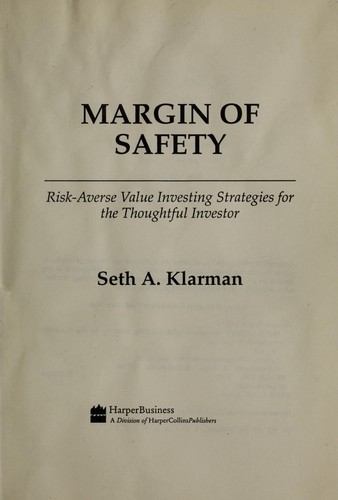
Margin of Safety is Seth Klarman's 1991 treatise on value investing, subtitled "Risk-Averse Value Investing Strategies for the Thoughtful Investor." The book has never been reprinted and used copies sell for hundreds to thousands of dollars, giving it a near-mythical status among serious investors. The title borrows a phrase from Benjamin Graham: always buy with a margin of safety, meaning only purchase an asset at a sufficient discount to its intrinsic value to protect against your own errors of analysis and unpredictable events.
Klarman opens with a lengthy critique of what he calls the institutional imperative: the tendency of professional money managers to chase performance benchmarks, avoid career risk by holding what everyone else holds, and treat market price as validation rather than as an input to be questioned. His argument is that this institutional behavior creates the persistent mispricings that value investors can exploit. Most of the book is about how to identify those mispricings, estimate intrinsic value with appropriate humility, and construct a portfolio that reflects the uncertainty inherent in all estimates.
What it gets right
- 1.
A margin of safety means buying at enough of a discount to intrinsic value that even significant errors in your analysis leave capital intact.
- 2.
Intrinsic value cannot be precisely calculated; it is a range, and the appropriate discount required for a margin of safety depends on how wide that range is.
- 3.
The institutional imperative pushes professional managers toward benchmark-hugging behavior that sacrifices independent judgment for career safety.
What it covers
Who wrote it
Seth Klarman is the founder and chief executive of Baupost Group, a Boston-based hedge fund managing approximately $30 billion in assets. He is widely considered one of the most successful value investors of his generation. Margin of Safety, written in 1991, has never been reprinted; it remains the only book he has published. Klarman studied under Michael Porter at Harvard Business School and worked at Mutual Shares Corporation under Max Heine before founding Baupost in 1982. He is known for maintaining discipline through extended periods of cash-holding when he finds no attractive opportunities.
