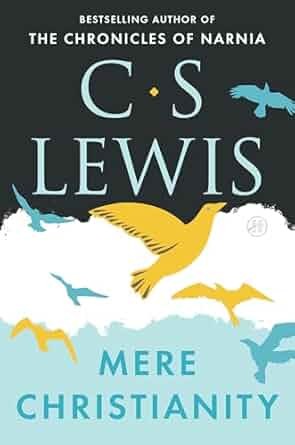
Talk to Mere Christianity like its author wrote you back.
Get the ideas that fit your life — not generic summaries.
- Chat with the book
- Audiobook-style main ideas
- Adapts to your life and goals
- Helps you take action
What it argues
Mere Christianity began as a series of BBC radio broadcasts Lewis gave during World War II, and the book retains that quality of direct, informal address. The title signals Lewis's intent: to describe not any denomination's specific doctrines but the common core of Christianity — the beliefs that Catholics, Protestants, and Orthodox Christians share. Lewis presents himself as a convert who came to Christianity through reason rather than upbringing, and the book's argument is shaped by that self-presentation.
The first section makes what Lewis calls the moral argument for the existence of God. He begins by observing that humans seem to have an innate sense of right and wrong — not identical across cultures but too consistent to be purely accidental. He argues this Moral Law cannot be explained by evolution alone (evolution explains what organisms do, not what they ought to do) and that its best explanation is a lawgiver outside nature. This is not new territory in philosophy, and Lewis knows it; the argument is not presented as a proof but as a reasonable inference from a strange fact about human experience.
What it gets right
- 1.
The Moral Law — the near-universal human sense of right and wrong — is a strange fact that evolutionary explanations don't fully account for, and Lewis uses it as the starting point for his argument toward God.
- 2.
Christianity is not a morality system. It claims to describe a transformation of human nature, not merely a set of rules to follow.
- 3.
Pride, Lewis argues, is the central sin — the competitive, hierarchical impulse to be better than others — and it is the one sin that makes you least able to see yourself clearly.
What it covers
Who wrote it
C. S. Lewis (1898–1963) was a British author and Oxford academic who lectured in English literature at both Oxford and Cambridge. Born into a Protestant family in Belfast, he became an atheist in his teens and returned to Christianity in his early thirties, a conversion he described in Surprised by Joy. His output spans scholarly literary criticism, fantasy fiction (The Chronicles of Narnia), and Christian apologetics. Mere Christianity, The Problem of Pain, and The Screwtape Letters remain among the most widely read works of Christian apologetics in English.
