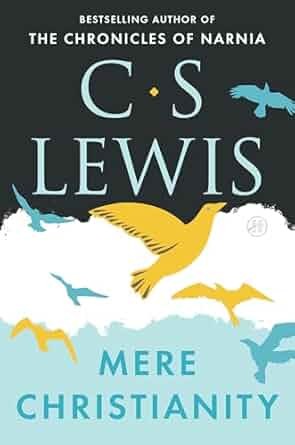
Mere Christianity by C. S. Lewis is a 1952 philosophy book about christianity, moral argument, faith. The Moral Law — the near-universal human sense of right and wrong — is a strange fact that evolutionary explanations don't fully account for, and Lewis uses it as the starting point for his argument toward God.
Summary
Mere Christianity began as a series of BBC radio broadcasts Lewis gave during World War II, and the book retains that quality of direct, informal address. The title signals Lewis's intent: to describe not any denomination's specific doctrines but the common core of Christianity — the beliefs that Catholics, Protestants, and Orthodox Christians share. Lewis presents himself as a convert who came to Christianity through reason rather than upbringing, and the book's argument is shaped by that self-presentation.
The first section makes what Lewis calls the moral argument for the existence of God. He begins by observing that humans seem to have an innate sense of right and wrong — not identical across cultures but too consistent to be purely accidental. He argues this Moral Law cannot be explained by evolution alone (evolution explains what organisms do, not what they ought to do) and that its best explanation is a lawgiver outside nature. This is not new territory in philosophy, and Lewis knows it; the argument is not presented as a proof but as a reasonable inference from a strange fact about human experience.
The second and third sections describe what Christianity claims about the nature of God, the purpose of humanity, and the meaning of Christ. Lewis is notably uninterested in miracles and evidential apologetics here. His focus is on the internal coherence of Christian claims and on the psychological and moral transformation that Christianity describes. His treatment of pride as the root sin, and of humility as its cure, is one of the most memorable passages in modern Christian writing.
The final section addresses practical Christian ethics and the nature of Christian charity, hope, and faith. Lewis distinguishes between faith in the sense of intellectual assent and faith in the sense of trust — and argues the latter is what Christian formation actually develops. Mere Christianity is not a work of academic theology. Its strength is Lewis's gift for analogy and his willingness to take the intellectual dimensions of belief seriously while writing in plain English. Its weakness, for some readers, is that the moral argument it rests on has been substantially contested by philosophers who find it less watertight than Lewis does.
Talk to Mere Christianity like its author wrote you back.
Get the ideas that fit your life — not generic summaries.
- Chat with the book
- Audiobook-style main ideas
- Adapts to your life and goals
- Helps you take action
Key takeaways
- 1.
The Moral Law — the near-universal human sense of right and wrong — is a strange fact that evolutionary explanations don't fully account for, and Lewis uses it as the starting point for his argument toward God.
- 2.
Christianity is not a morality system. It claims to describe a transformation of human nature, not merely a set of rules to follow.
- 3.
Pride, Lewis argues, is the central sin — the competitive, hierarchical impulse to be better than others — and it is the one sin that makes you least able to see yourself clearly.
- 4.
Christian morality has three components: relations between humans, human character development, and humans' relation to whatever created them. All three are necessary.
- 5.
Faith in the full Christian sense is not credulity or ignoring evidence. It is the discipline of holding on to conclusions arrived at by reason against the shifting moods of experience.
- 6.
The Christian claim about Christ is that he was either who he said he was, or a lunatic, or a deliberate liar. Lewis argues the latter two options are harder to maintain on historical grounds than the first.
- 7.
Practical virtues — prudence, justice, temperance, fortitude — are not invented by Christianity but are taken up into it. The new element Christianity adds is charity.
- 8.
The Christian hope is not optimism about this world. It is the claim that human longing for what this world never fully provides is evidence of a destination outside it.
Discussion questions
Use these on your own, with a book club, or as chat starters in Superbook. Book club version, ready to copy or print →
- 1.
Lewis starts with the Moral Law as evidence of God. Does that argument work for you? What would it take to explain the near-universality of moral intuitions without a divine lawgiver?
- 2.
He argues that Christ must be Lord, liar, or lunatic. What are the strongest objections to that trilemma, and how well does Lewis anticipate them?
- 3.
Lewis presents himself as an outsider who reasoned his way in. How much does that framing affect how the argument lands for you?
- 4.
His treatment of pride as the root sin is one of the book's most admired passages. Where do you see pride operating in your own life in the way Lewis describes it?
- 5.
Lewis distinguishes 'nice people' from 'new people' — suggesting that morality's aim is transformation, not niceness. What's the practical difference?
- 6.
The book was written during World War II. Which of Lewis's concerns feel historically situated, and which feel timeless?
- 7.
Lewis writes as a defender of 'mere Christianity' — the common core. Does that approach let him avoid the hardest questions, or is it a genuine strength?
- 8.
He argues that human desire for something this world cannot provide points toward another world. Does that argument convince you, or does it feel like a non-sequitur?
- 9.
Lewis treats sexual morality at some length. Does his treatment of it hold up by contemporary standards, and does it affect your assessment of the rest of the argument?
- 10.
If you were to write the strongest critique of Mere Christianity from a secular position, what would it say?
- 11.
Lewis compares God to a dentist whose pain is necessary for health. What other metaphors does he use effectively, and where do they break down?
- 12.
Would someone with no prior exposure to Christian ideas find Lewis's argument compelling today? How much does the book assume its reader already half-believes?
Themes
Frequently asked questions
-
What is Mere Christianity about?
It's C. S. Lewis's accessible defense of the core claims of Christianity — stripped of denominational specifics. He starts with the moral argument for God's existence and moves through the nature of Christian belief, ethics, and the transformation Christianity claims to produce in human beings.
-
Is Mere Christianity worth reading for non-Christians?
Yes, particularly for anyone interested in understanding why intelligent people find Christianity compelling. Lewis is a skilled apologist who engages with objections seriously. Whether or not his argument succeeds, it's a better version of the case than most readers have encountered.
-
How long does it take to read Mere Christianity?
About five hours. At roughly 230 pages with relatively short chapters, it reads quickly. The BBC origins of the material mean each section is self-contained and the prose is conversational.
-
What is Lewis's main argument in Mere Christianity?
That the universal human sense of moral obligation points toward a moral lawgiver, that Christian claims about Christ are the most coherent explanation of the historical record, and that Christianity describes not a set of rules to follow but a transformation of human nature.
-
Who should read Mere Christianity?
Christians who want a clearer articulation of what they believe, skeptics curious about the best popular version of the Christian case, and anyone interested in how faith and reason relate. It's not an academic theology text — the intended reader is someone willing to think hard in plain English.