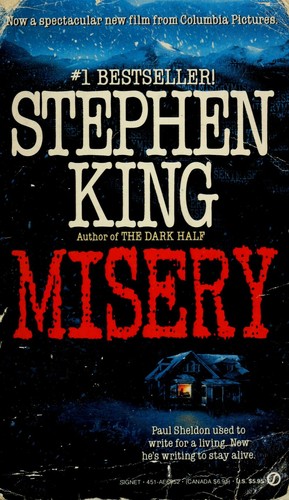
Talk to Misery like its author wrote you back.
Get the ideas that fit your life — not generic summaries.
- Chat with the book
- Audiobook-style main ideas
- Adapts to your life and goals
- Helps you take action
What it argues
Paul Sheldon, a bestselling novelist, crashes his car in a Colorado blizzard. He is rescued by Annie Wilkes — former nurse, self-described Number One Fan — who keeps him in her remote farmhouse while his pelvis heals. Annie has also read his latest manuscript, in which Paul has killed off his most beloved character, the Victorian romance heroine Misery Chastain. She wants him to bring Misery back. She has leverage. And she is, in ways that clarify gradually, profoundly and specifically dangerous.
King wrote Misery partly as a metaphor for his own relationship with addiction — the captive novelist, the demanding audience, the work produced under compulsion rather than freedom — and that autobiographical layer gives the novel a depth that pure horror wouldn't achieve. Annie is one of his most fully realized antagonists precisely because she isn't simply evil. She loves Paul's work with complete sincerity. Her demand that he honor his characters is not wrong in its basic shape; her methods are simply catastrophic. The novel asks what a writer owes the audience that loves what he creates — and finds no comfortable answer.
What it gets right
- 1.
Annie Wilkes is terrifying not despite loving Paul's work but because of it — her attachment to the character of Misery is entirely genuine, and her demand for resurrection is a reader's complaint taken to its logical extreme.
- 2.
King wrote the novel as an allegory for his cocaine addiction: the captive novelist producing work under compulsion is an image of the writer who can't stop, even when the work is killing him.
- 3.
The book-within-the-book — Misery's Return — is excerpted at length, and King makes it good enough that the reader genuinely cares whether Paul finishes it. This is a technical achievement, not a gesture.
What it covers
Who wrote it
Stephen King is the author of more than sixty novels and two hundred short stories, including It, The Shining, Pet Sematary, Carrie, and The Stand. He is among the bestselling novelists in history and is widely credited with legitimizing horror as a genre capable of serious literary ambition. He has won the National Medal of Arts, the Grand Master Award from the Mystery Writers of America, and the National Book Foundation Medal for Distinguished Contribution to American Letters. On Writing, his memoir and craft guide published in 2000, is among the most widely read books on the practice of fiction. He lives in Maine.
