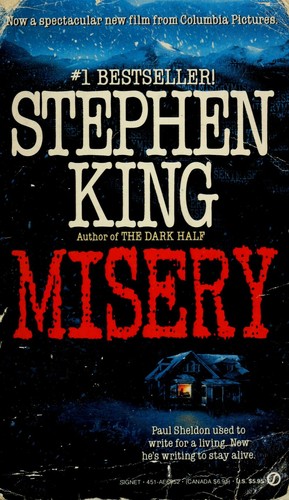
Misery by Stephen King is a 1987 thriller book about creation and captivity, fan obsession, addiction and recovery. Annie Wilkes is terrifying not despite loving Paul's work but because of it — her attachment to the character of Misery is entirely genuine, and her demand for resurrection is a reader's complaint taken to its logical extreme.
Summary
Paul Sheldon, a bestselling novelist, crashes his car in a Colorado blizzard. He is rescued by Annie Wilkes — former nurse, self-described Number One Fan — who keeps him in her remote farmhouse while his pelvis heals. Annie has also read his latest manuscript, in which Paul has killed off his most beloved character, the Victorian romance heroine Misery Chastain. She wants him to bring Misery back. She has leverage. And she is, in ways that clarify gradually, profoundly and specifically dangerous.
King wrote Misery partly as a metaphor for his own relationship with addiction — the captive novelist, the demanding audience, the work produced under compulsion rather than freedom — and that autobiographical layer gives the novel a depth that pure horror wouldn't achieve. Annie is one of his most fully realized antagonists precisely because she isn't simply evil. She loves Paul's work with complete sincerity. Her demand that he honor his characters is not wrong in its basic shape; her methods are simply catastrophic. The novel asks what a writer owes the audience that loves what he creates — and finds no comfortable answer.
The craft is exceptional. King strips the novel to its essential elements — one room, two people, a typewriter, and the manuscript of a book-within-the-book that the reader gradually cares about as much as Paul does — and builds sustained dread from almost nothing. The pacing in the middle sections, where Paul begins writing Misery's Return and the novel reproduces substantial excerpts, is a structural risk that pays off: the reader is invested in both the plot and the embedded Victorian romance, which makes Paul's survival feel like it matters beyond the thriller mechanics.
Misery is not King's most ambitious novel, but it may be his most controlled. It's also the one that has aged most interestingly: the questions it raises about celebrity, fan culture, and the writer-reader relationship read differently now than they did in 1987. It's a book about being owned by your own audience, written by a man who genuinely knew what that felt like.
Talk to Misery like its author wrote you back.
Get the ideas that fit your life — not generic summaries.
- Chat with the book
- Audiobook-style main ideas
- Adapts to your life and goals
- Helps you take action
Key takeaways
- 1.
Annie Wilkes is terrifying not despite loving Paul's work but because of it — her attachment to the character of Misery is entirely genuine, and her demand for resurrection is a reader's complaint taken to its logical extreme.
- 2.
King wrote the novel as an allegory for his cocaine addiction: the captive novelist producing work under compulsion is an image of the writer who can't stop, even when the work is killing him.
- 3.
The book-within-the-book — Misery's Return — is excerpted at length, and King makes it good enough that the reader genuinely cares whether Paul finishes it. This is a technical achievement, not a gesture.
- 4.
The novel strips the thriller to its most minimal conditions: one room, one captor, one captive, one typewriter. The constraint produces intensity rather than claustrophobia.
- 5.
Paul's gradually evolving relationship to the Misery character — from contempt to genuine engagement to something like love — mirrors King's own complicated relationship to commercial fiction versus serious literary ambition.
- 6.
The novel's portrait of fame in 1987 predicted parasocial celebrity culture with uncomfortable accuracy: Annie is a fan who has been given nothing by Paul but who feels owed everything.
- 7.
Survival in the novel requires Paul to engage fully with the work Annie has demanded, not to fake it. His way out runs through the manuscript, not around it.
- 8.
The hobbling scene — among the most viscerally unpleasant in King's career — is positioned strategically to communicate something about power that the preceding psychological tension had been building toward.
Discussion questions
Use these on your own, with a book club, or as chat starters in Superbook. Book club version, ready to copy or print →
- 1.
Annie argues, in her own way, that Paul betrayed Misery Chastain and betrayed her readers by killing the character off. Is she entirely wrong? What does a popular fiction writer owe the audience that made them successful?
- 2.
King has been explicit that Paul's captivity is partly an allegory for cocaine addiction. Does reading it as such change how you interpret Paul's relationship to the work he produces while imprisoned?
- 3.
Annie's love for the Misery novels is presented as real and complete, not as a delusion. What is the novel saying about the relationship between genuine literary love and the capacity for violence?
- 4.
The excerpts from Misery's Return are good. King writes them as intentionally competent commercial Victorian romance. Did you find yourself caring about Misery Chastain? What did that caring feel like?
- 5.
Paul is a writer who has always been somewhat ashamed of his most beloved work. The novel forces him into a full reckoning with it. By the end, does he come to respect it? Does the novel ask you to?
- 6.
Compare Annie Wilkes to other antagonists you've encountered — in King or elsewhere. What specifically makes her frightening: her intelligence, her sincerity, her unpredictability, or something harder to name?
- 7.
The hobbling scene is a structural inflection point. Why do you think King placed it where he did — what does it change about the dynamic between Paul and Annie, and between the reader and the novel?
- 8.
The novel was written in 1987, but its portrait of fan obsession reads very differently now. What has changed, and what does Misery look like as a text about contemporary celebrity culture?
- 9.
Paul's ability to produce the manuscript under duress is itself a form of power — the one thing Annie can't do without him. How does the novel use that dependency as a structural element?
- 10.
Is there a version of Annie's demand that Paul would have received sympathetically in other circumstances — a letter, a petition, a Twitter campaign? What makes the demand valid and the method monstrous?
- 11.
The ending gives Paul survival and, eventually, success. Does the novel earn that ending, or does it let him off too easily given what he was forced to confront about himself?
- 12.
King has said he doesn't remember writing parts of this novel because of his addiction at the time. Does knowing that shape how you read the captivity metaphor?
Themes
Frequently asked questions
-
Is Misery worth reading even if you don't usually read horror?
Yes. Misery is more psychological thriller than horror — there are no supernatural elements. The dread is entirely human in origin, and the novel's observations about creativity, addiction, and the writer-reader relationship give it staying power beyond the genre.
-
Is it King's best book?
Not his most ambitious, but arguably his most controlled. It has no supernatural element, no sprawling cast, no tonal range — just two people in a room and a typewriter. Within those constraints, it's nearly perfect.
-
Is the hobbling scene as bad as people say?
It's upsetting in the way it's meant to be, not gratuitously. King uses it to mark a threshold in the story — before it, Paul retains some degree of hope and agency; after it, the nature of the captivity is definitively established. It's brief but it lands hard.
-
Is there a film adaptation?
Yes. The 1990 film starred James Caan as Paul Sheldon and Kathy Bates as Annie Wilkes. Bates won the Academy Award for Best Actress. The film is excellent and closer in tone to the novel than most King adaptations manage.
-
Who shouldn't read this?
Readers who are deeply averse to scenes of physical harm to a protagonist, or who find claustrophobic single-setting narratives suffocating rather than tense. Also readers looking for a supernatural horror novel — this has none.
Similar books
The Silent Patient
Alex Michaelides

The Gift of Fear: Survival Signals That Protect Us from Violence
Gavin de Becker
In Cold Blood
Truman Capote
Helter Skelter: The True Story of the Manson Murders
Vincent Bugliosi and Curt Gentry
