Talk to Mistakes Were Made (But Not by Me) like its author wrote you back.
Get the ideas that fit your life — not generic summaries.
- Chat with the book
- Audiobook-style main ideas
- Adapts to your life and goals
- Helps you take action
What it argues
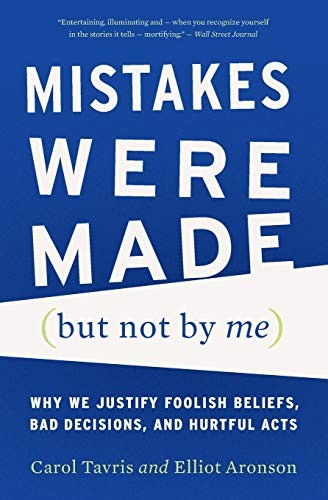
Carol Tavris and Elliot Aronson wrote this book about the mechanisms by which people protect their sense of themselves as competent, moral, and well-intentioned after they have done something that contradicts that self-image. The core concept is cognitive dissonance, Leon Festinger's discovery that holding two contradictory beliefs or a belief and a contradicting action produces psychological discomfort — and that humans will do remarkable mental work to resolve that discomfort, almost always in the direction of preserving the original belief.
The book's central insight is that self-justification is not the same as lying. When people deny mistakes, reframe them, or remember them differently, they are usually not consciously deciding to deceive. They genuinely come to believe the revised version. Memory is reconstructive, not archival. What we remember is shaped by what we currently believe, who we currently are, and what we need to have been true. This makes retrospective accounts unreliable and makes confronting people with their past behavior less effective than it might seem.
What it gets right
- 1.
Self-justification is not conscious lying. When people minimize or reframe their mistakes, they usually come to genuinely believe the revised account.
- 2.
Cognitive dissonance is the discomfort of holding contradictory beliefs or acting against one's values. People resolve it by changing one of the elements — almost always the less costly one.
- 3.
Memory is reconstructive, not archival. What we remember is shaped by what we currently believe and need to have been true. Eyewitness memory and autobiographical memory are both unreliable in predictable ways.
What it covers
Who wrote it
Carol Tavris is a social psychologist and writer whose work focuses on cognitive bias, emotional life, and scientific skepticism. She is the author of Anger: The Misunderstood Emotion and has written widely on women's health, therapy, and the misuse of psychological research. Elliot Aronson is professor emeritus of psychology at the University of California, Santa Cruz, and one of the most cited social psychologists in history. He developed dissonance theory applications with Leon Festinger and has written The Social Animal, a widely used introduction to social psychology. Their collaboration on this book combines Tavris's journalism and Aronson's experimental background.
