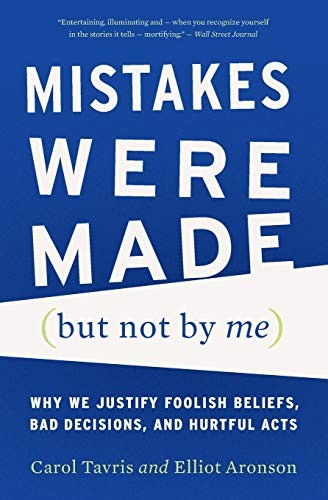
Mistakes Were Made (But Not by Me) by Carol Tavris and Elliot Aronson is a 2007 psychology book about self-justification, cognitive dissonance, memory. Self-justification is not conscious lying. When people minimize or reframe their mistakes, they usually come to genuinely believe the revised account.
Summary
Carol Tavris and Elliot Aronson wrote this book about the mechanisms by which people protect their sense of themselves as competent, moral, and well-intentioned after they have done something that contradicts that self-image. The core concept is cognitive dissonance, Leon Festinger's discovery that holding two contradictory beliefs or a belief and a contradicting action produces psychological discomfort — and that humans will do remarkable mental work to resolve that discomfort, almost always in the direction of preserving the original belief.
The book's central insight is that self-justification is not the same as lying. When people deny mistakes, reframe them, or remember them differently, they are usually not consciously deciding to deceive. They genuinely come to believe the revised version. Memory is reconstructive, not archival. What we remember is shaped by what we currently believe, who we currently are, and what we need to have been true. This makes retrospective accounts unreliable and makes confronting people with their past behavior less effective than it might seem.
Tavris and Aronson apply this framework to politicians, therapists who implant false memories, police interrogators who produce false confessions, prosecutors who refuse to reconsider convictions even in the face of DNA evidence, and couples trapped in cycles of mutual accusation. Each case illustrates how the pyramid of choice — small initial decisions followed by justifications that make the next decision easier — can lead people who started with good intentions to places they could not have imagined taking themselves.
The book ends with a sustained argument for what it would take to build genuine accountability — in individuals, relationships, and institutions. It requires treating error not as moral failure but as information, and it requires building structures that make acknowledgment less costly. This is a practical book dressed as psychology, and the practical implications are genuinely useful.
Talk to Mistakes Were Made (But Not by Me) like its author wrote you back.
Get the ideas that fit your life — not generic summaries.
- Chat with the book
- Audiobook-style main ideas
- Adapts to your life and goals
- Helps you take action
Key takeaways
- 1.
Self-justification is not conscious lying. When people minimize or reframe their mistakes, they usually come to genuinely believe the revised account.
- 2.
Cognitive dissonance is the discomfort of holding contradictory beliefs or acting against one's values. People resolve it by changing one of the elements — almost always the less costly one.
- 3.
Memory is reconstructive, not archival. What we remember is shaped by what we currently believe and need to have been true. Eyewitness memory and autobiographical memory are both unreliable in predictable ways.
- 4.
The pyramid of choice describes how small initial decisions accumulate into commitments. Each step makes the next one easier, and self-justification fills the gaps between them.
- 5.
Confirmation bias and self-justification work together. Once we have a belief, we seek evidence that confirms it and discount evidence that contradicts, making genuine updating rare.
- 6.
Institutional self-justification is at least as powerful as individual self-justification. Organizations that invest in a theory or a conviction will construct elaborate defenses rather than acknowledge error.
- 7.
False memories are real. Therapists who believe they are recovering repressed trauma and interrogators who believe they have the right suspect can produce memories in clients and suspects that are experienced as genuine but are not.
- 8.
Accountability requires reducing the cost of acknowledging error. Cultures that treat mistakes as moral failures guarantee that mistakes will be denied.
Discussion questions
Use these on your own, with a book club, or as chat starters in Superbook. Book club version, ready to copy or print →
- 1.
Think of a time you justified a mistake rather than acknowledging it. Can you trace the cognitive dissonance that drove the justification?
- 2.
The book argues that memory is reconstructed to fit current beliefs. Has there been a case in your life where your memory of an event shifted as your interpretation of it changed?
- 3.
Tavris and Aronson describe the pyramid of choice: small initial decisions that make later ones harder to reverse. Where in your life have you noticed that escalating commitment?
- 4.
They argue that confirmation bias means we rarely update beliefs on the basis of evidence. What is a belief you currently hold that you have genuinely updated in response to new evidence?
- 5.
The chapters on false memory and false confession suggest that sincere belief is not a reliable guide to truth. What are the implications for how we treat testimony and personal accounts?
- 6.
They discuss therapists and prosecutors who cannot acknowledge being wrong without dismantling their professional identity. How does professional identity make self-justification worse?
- 7.
What would it take to build an institutional culture where acknowledging error was less costly? Can you think of an organization that has done this successfully?
- 8.
The book argues couples are often trapped in mutual self-justification cycles. What would genuine accountability in a close relationship look like, and how is it different from blame?
- 9.
Is there a public figure whose self-justification you find particularly visible or particularly instructive?
- 10.
Tavris and Aronson suggest we can inoculate ourselves against self-justification by cultivating a psychology of error as information. What would that cultivation look like in practice?
- 11.
Which of the case studies in the book — politicians, therapists, prosecutors, couples — did you find most surprising, and why?
Themes
Frequently asked questions
-
Is this book about political spin?
Not primarily. The book uses political examples, but its scope is much wider. It is about the universal human tendency to protect a positive self-image by justifying mistakes, and it applies equally to individuals, couples, therapists, and institutions.
-
What is cognitive dissonance?
The discomfort that results from holding two contradictory beliefs or from acting in a way that conflicts with one's beliefs. Festinger discovered that people resolve this discomfort by changing one element — usually the less threatening one — and that this process is largely unconscious.
-
What is the most important practical insight?
That acknowledging mistakes early and cheaply prevents them from accumulating into large commitments you cannot afford to reverse. The pyramid of choice means that the longer you wait, the harder it gets.
-
Is this book relevant to therapy?
Directly. Several chapters examine how therapists can implant false memories while sincerely believing they are helping, and how confirmation bias in clinical work can harm clients. Anyone in a therapeutic or helping profession should read these sections.
-
Who should read this book?
Anyone who has noticed that confronting people with their mistakes rarely works. Also valuable for managers, couples, anyone in a legal or judicial role, and anyone trying to build a culture of genuine accountability.
Similar books
Thinking, Fast and Slow
Daniel Kahneman
The Lucifer Effect: Understanding How Good People Turn Evil
Philip Zimbardo
You Are Not So Smart
David McRaney
Stumbling on Happiness
Daniel Gilbert
