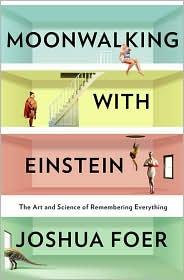
Talk to Moonwalking with Einstein like its author wrote you back.
Get the ideas that fit your life — not generic summaries.
- Chat with the book
- Audiobook-style main ideas
- Adapts to your life and goals
- Helps you take action
What it argues
Moonwalking with Einstein is Joshua Foer's account of spending a year training for and winning the United States Memory Championship, beginning as a journalist covering the event and ending as its champion. The book weaves together Foer's personal training story and a broader investigation into the history and science of memory — how it works, how it has been understood across cultures, and what the strange subculture of competitive memorization reveals about human cognition.
The central practical thread is the method of loci, also called the memory palace technique. Foer works with Ed Cooke, a British memory champion and coach, who teaches him to encode information as vivid, bizarre, spatial images placed along a familiar mental route. Names become substitute images, cards become characters, numbers become sounds. The technique is ancient — described by Cicero, attributed to the Greek poet Simonides — and modern competitive memory sport is largely an elaboration of the same system. Foer's training shows both the power of the method and how much practice is required to make it reliable.
What it gets right
- 1.
The method of loci — placing vivid mental images along a familiar route — is the foundation of virtually all competitive memory performance. It works because human spatial and episodic memory is far stronger than verbal memory.
- 2.
Memory champions are not born with exceptional memories. Studies of their brains show no structural differences from non-experts. What they have is a technique and the practice hours to make it automatic.
- 3.
The shift from oral to literate culture changed the status of memory. Before books, the trained ability to internalize and recite large bodies of knowledge was a primary intellectual virtue; after books, external storage replaced internal storage.
What it covers
Who wrote it
Joshua Foer is an American science journalist whose work has appeared in National Geographic, The New York Times, Esquire, and other publications. He won the United States Memory Championship in 2006, the event that forms the central narrative of Moonwalking with Einstein. He is a co-founder of the Atlas Obscura travel and culture website and co-author of the Atlas Obscura book. His writing explores the intersection of science, human behavior, and unusual subcultures.
