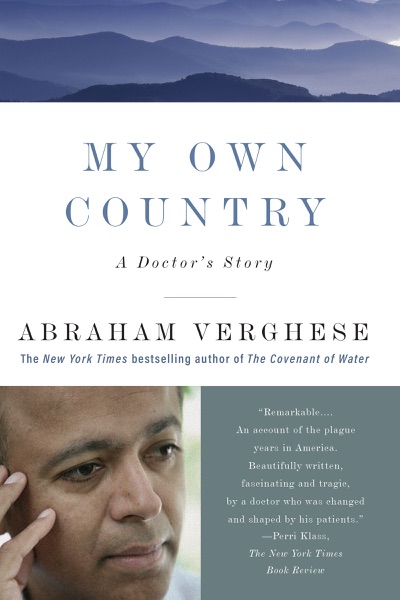
Talk to My Own Country: A Doctor's Story like its author wrote you back.
Get the ideas that fit your life — not generic summaries.
- Chat with the book
- Audiobook-style main ideas
- Adapts to your life and goals
- Helps you take action
What it argues
My Own Country is Abraham Verghese's account of his years as an infectious disease specialist in Johnson City, Tennessee, during the early years of the AIDS epidemic. Verghese, who was born in Ethiopia to Indian parents and trained in medicine in India before emigrating to the United States, arrived in Appalachia as an outsider and found himself at the center of an epidemic that was, in the mid-1980s, presumed to belong to cities. What he found instead was a steady stream of gay men who had left rural Tennessee for New York, San Francisco, and Atlanta — and who, when they became sick, came home to die.
The book is a portrait of two communities discovering each other under the worst possible circumstances. The gay men returning to Johnson City had mostly kept their lives secret from their families; the families, often deeply religious and culturally conservative, had to confront both their child's illness and their child's life simultaneously. Verghese treats these encounters with great care. He is neither a moralist nor a sentimentalist. He records what happened in the exam room, the hospital, the home, with the kind of attention that comes from a doctor who understood that treating AIDS at that moment meant treating the whole human context of illness.
What it gets right
- 1.
The AIDS epidemic in rural America was shaped by the pattern of gay men leaving small towns and returning home when they became ill, a dynamic that brought the epidemic to places assumed to be unaffected.
- 2.
Treating AIDS in the 1980s was almost entirely palliative — Verghese's role was accompaniment through dying rather than cure, which required a different kind of medical practice.
- 3.
Verghese's outsider identity as an immigrant and a person of color in Appalachia gave him unusual access to communities that might not have trusted a local doctor.
What it covers
Who wrote it
Abraham Verghese is a physician, professor, and writer born in Ethiopia to Indian parents. He trained in medicine in India and Ethiopia before completing his residency in the United States, eventually specializing in infectious disease. He is a professor at Stanford University School of Medicine, where he is known for his emphasis on the physical examination and the doctor-patient relationship. He has written three books, including My Own Country, The Tennis Partner, and the novel The Covenant of Water. He has given a widely viewed TED Talk on the importance of the ritual of physical examination in medicine.
