Talk to Myths to Live By like its author wrote you back.
Get the ideas that fit your life — not generic summaries.
- Chat with the book
- Audiobook-style main ideas
- Adapts to your life and goals
- Helps you take action
Myths to Live By, in detail
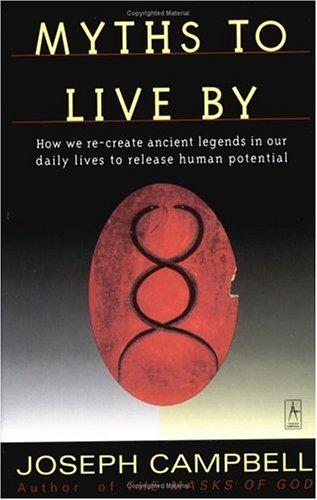
Myths to Live By collects a series of lectures Joseph Campbell delivered at Cooper Union in New York City between 1958 and 1971. The result is an unusually accessible entry point into Campbell's lifelong project: arguing that mythology is not primitive error or literary decoration but the essential symbolic language through which human beings have always oriented themselves in the cosmos and navigated the passages of individual life.
The book's argument unfolds across diverse topics — Eastern and Western mythology, space exploration, schizophrenia, the relationship between Freud and myth, the significance of yoga, the encounter between science and religion, and the particular psychological challenges of modern Western life. The connecting thread is Campbell's insistence that mythic symbolism addresses permanent features of human experience: the mystery of consciousness, the terror of death, the need for initiation and transformation, the desire for union with something larger than the ego. These needs do not disappear in secular modernity; they simply go unmet, or get met in degraded ways.
Campbell is particularly sharp on the crisis of contemporary Western culture. The traditional mythologies — Christian and otherwise — have lost their power to move most educated people, and nothing has replaced them at the level of genuine symbolic resonance. Science describes the how of the universe but not the why. The result, in Campbell's diagnosis, is a population that is materially comfortable and symbolically starved, prone to either fundamentalist literalism (treating myth as fact) or cynical dismissal (treating myth as falsehood), while missing the middle ground where myth actually works.
Myths to Live By is not a scholarly work in the technical sense. Campbell ranges freely, and some of his comparisons among world mythologies are too quick. But the lectures retain their original energy, and the central questions Campbell keeps returning to — what stories help us live, what stories help us die, and what do we lose when we lose them — have only become more pressing in the decades since they were delivered.
The big ideas
- 1.
Myths are not primitive science or false history. They are symbolic maps for navigating the universal passages of human life: birth, initiation, love, death, and the encounter with the sacred.
- 2.
The same mythological motifs — the hero's journey, the underworld descent, the dying and rising god — appear independently across cultures because they address the same permanent features of human psychology.
- 3.
Modern Western culture faces a mythological crisis: the traditional symbols have lost their power, and nothing has emerged to replace them at the level of genuine symbolic resonance.
