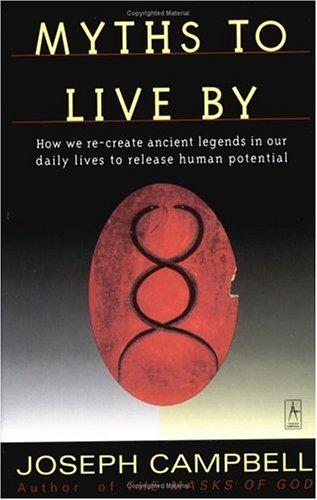
Myths to Live By by Joseph Campbell is a 1972 philosophy book about mythology, religion, modern meaning. Myths are not primitive science or false history. They are symbolic maps for navigating the universal passages of human life: birth, initiation, love, death, and the encounter with the sacred.
Summary
Myths to Live By collects a series of lectures Joseph Campbell delivered at Cooper Union in New York City between 1958 and 1971. The result is an unusually accessible entry point into Campbell's lifelong project: arguing that mythology is not primitive error or literary decoration but the essential symbolic language through which human beings have always oriented themselves in the cosmos and navigated the passages of individual life.
The book's argument unfolds across diverse topics — Eastern and Western mythology, space exploration, schizophrenia, the relationship between Freud and myth, the significance of yoga, the encounter between science and religion, and the particular psychological challenges of modern Western life. The connecting thread is Campbell's insistence that mythic symbolism addresses permanent features of human experience: the mystery of consciousness, the terror of death, the need for initiation and transformation, the desire for union with something larger than the ego. These needs do not disappear in secular modernity; they simply go unmet, or get met in degraded ways.
Campbell is particularly sharp on the crisis of contemporary Western culture. The traditional mythologies — Christian and otherwise — have lost their power to move most educated people, and nothing has replaced them at the level of genuine symbolic resonance. Science describes the how of the universe but not the why. The result, in Campbell's diagnosis, is a population that is materially comfortable and symbolically starved, prone to either fundamentalist literalism (treating myth as fact) or cynical dismissal (treating myth as falsehood), while missing the middle ground where myth actually works.
Myths to Live By is not a scholarly work in the technical sense. Campbell ranges freely, and some of his comparisons among world mythologies are too quick. But the lectures retain their original energy, and the central questions Campbell keeps returning to — what stories help us live, what stories help us die, and what do we lose when we lose them — have only become more pressing in the decades since they were delivered.
Talk to Myths to Live By like its author wrote you back.
Get the ideas that fit your life — not generic summaries.
- Chat with the book
- Audiobook-style main ideas
- Adapts to your life and goals
- Helps you take action
Key takeaways
- 1.
Myths are not primitive science or false history. They are symbolic maps for navigating the universal passages of human life: birth, initiation, love, death, and the encounter with the sacred.
- 2.
The same mythological motifs — the hero's journey, the underworld descent, the dying and rising god — appear independently across cultures because they address the same permanent features of human psychology.
- 3.
Modern Western culture faces a mythological crisis: the traditional symbols have lost their power, and nothing has emerged to replace them at the level of genuine symbolic resonance.
- 4.
Myth operates on two levels simultaneously: an inward, psychological level (the transformation of consciousness) and an outward, social level (the maintenance of the community and its relationship to the cosmos).
- 5.
The failure to provide meaningful rites of initiation is a serious problem in modern Western societies. Without genuine initiation, adolescent energies find no channel and the transition to adult responsibility remains incomplete.
- 6.
Science describes the how of the universe but cannot address the why — the felt mystery of existence, the significance of suffering and death, the meaning of love. These are properly mythological territory.
- 7.
Mystical experience — the dissolution of the boundary between self and world — is the fundamental core of religious life across traditions. Institutional religion serves to manage and transmit that experience, but the experience itself is primary.
- 8.
The living myth is not believed literally but participated in symbolically. When myth is taken as fact rather than as symbol, it hardens into dogma and loses its psychological power.
Discussion questions
Use these on your own, with a book club, or as chat starters in Superbook. Book club version, ready to copy or print →
- 1.
Campbell argues that myth addresses permanent features of human experience. Which mythological motifs or stories resonate with you most strongly, and why do you think they do?
- 2.
What functions as myth for you now — the stories or symbolic systems through which you orient yourself in life? Are they serving you well?
- 3.
Campbell says the crisis of modern Western culture is that traditional symbols have lost their power. Do you agree? What do you see filling the gap?
- 4.
Modern Western society largely lacks formal initiation rites for adolescents. What effects of that absence do you see in the culture around you, or in your own experience?
- 5.
Campbell distinguishes between participating in myth symbolically and believing it literally. Is that distinction stable? Can myth retain its power once you know it is symbolic rather than factual?
- 6.
Campbell treats mystical experience as the core of religion and institutional religion as a delivery mechanism. Does that hierarchy match your own understanding of religious life?
- 7.
Where in contemporary culture do you see mythological thinking operating under secular or political labels — rituals, heroes, founding narratives, sacred spaces?
- 8.
Campbell is optimistic that the world's mythologies share a common core. Critics argue this glosses over genuine differences. Which view do you find more persuasive, and why?
- 9.
Science can tell us how the universe works but not what it means. Is that a real gap, or is meaning itself a mythological category we should be learning to live without?
- 10.
What would it look like to take a myth seriously as symbol rather than as fact? Is that possible without losing its affective and motivating force?
- 11.
Campbell spent his career arguing that mythology is essential to human life. Has engaging with his argument changed how you relate to any of the stories you live by?
Themes
Frequently asked questions
-
What is Myths to Live By about?
It is a collection of lectures in which Joseph Campbell explores the psychological and cultural functions of mythology. Campbell argues that myths are not primitive error but essential symbolic maps for navigating human experience, and that modern Western culture is suffering from the loss of effective mythological grounding.
-
Is Myths to Live By a good introduction to Campbell?
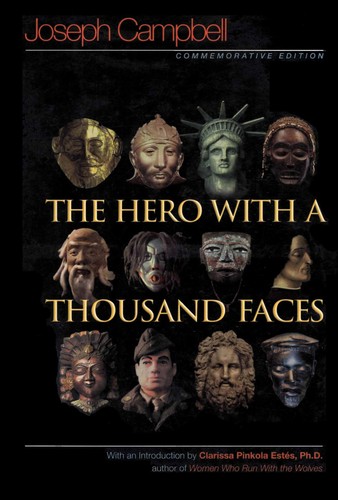
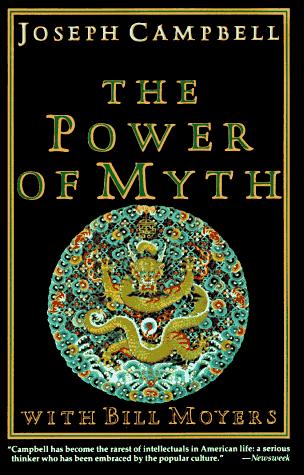
Yes, it is one of the most accessible points of entry. The lectures are conversational rather than scholarly, and the range of topics gives a broad overview of Campbell's concerns. Readers who want more depth can move from here to The Hero with a Thousand Faces or The Power of Myth.
-
How long does it take to read Myths to Live By?
About four to five hours at average reading pace. The book is around 280 pages in most editions. The lecture format makes for relatively fast reading.
-
Who should read Myths to Live By?
Anyone curious about the role of myth and symbol in human life, the relationship between religion and psychology, or the particular meaning-crisis of contemporary secular culture. It rewards readers with some background in world religions or classical mythology, but prior knowledge is not required.
-
Does Campbell's comparative approach hold up to scholarly scrutiny?
Partially. His observation that similar motifs appear across cultures is well-documented. His claim that these motifs share a single underlying meaning has attracted serious criticism from scholars who emphasize cultural specificity. Reading Campbell alongside critics like Wendy Doniger or Robert Ellwood gives a fuller picture.