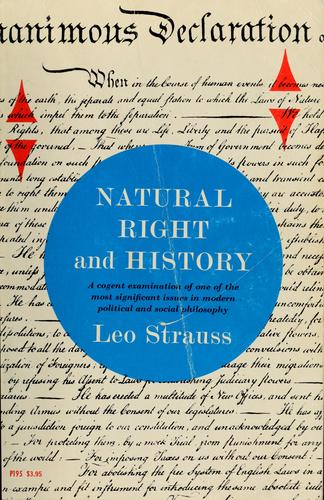
Talk to Natural Right and History like its author wrote you back.
Get the ideas that fit your life — not generic summaries.
- Chat with the book
- Audiobook-style main ideas
- Adapts to your life and goals
- Helps you take action
What it argues
Natural Right and History is Leo Strauss's sustained argument that the modern rejection of natural right — the idea that there is a standard of justice discoverable by reason, independent of convention and history — represents a profound intellectual and political crisis. Delivered as the Walgreen Lectures at the University of Chicago in 1949 and published in 1953, the book is simultaneously a critique of modern political philosophy, a recovery of ancient Greek thought, and a warning about the political consequences of relativism.
Strauss begins by distinguishing natural right from natural law in the theological sense. His concern is with the philosophical question: is there any standard of justice that is not merely the product of a given culture, historical period, or act of political will? He identifies two modern doctrines that deny this possibility. The first is historicism — the view that all thought is conditioned by its historical situation, so that no claim to universal validity can be made. The second is what he calls the "value positivism" of Max Weber: the view that science can describe facts but cannot adjudicate between ultimate values, which are a matter of choice rather than reason.
What it gets right
- 1.
Natural right is the claim that there is a standard of justice discoverable by reason, independent of historical convention or political authority. Strauss argues this claim cannot be abandoned without serious consequences.
- 2.
Historicism — the view that all thought is historically conditioned and therefore that no universal standards are possible — is Strauss's primary target. He argues it is self-refuting and politically paralyzing.
- 3.
Weber's value positivism holds that science can describe facts but cannot adjudicate between ultimate values. Strauss argues this leaves political life without any rational defense against nihilism.
What it covers
Who wrote it
Leo Strauss (1899–1973) was a German-born political philosopher who emigrated to the United States in 1938 after fleeing Nazi Germany. He taught at the New School for Social Research and then at the University of Chicago, where he became one of the most influential and controversial figures in twentieth-century political philosophy. His work focused on the history of political thought, the tension between philosophy and politics, and the recovery of ancient wisdom against modern relativism. Major works include Persecution and the Art of Writing (1952), The City and Man (1964), and Thoughts on Machiavelli (1958).
