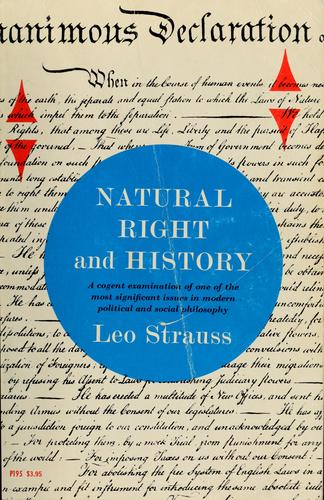
Natural Right and History by Leo Strauss is a 1953 philosophy book about natural right, political philosophy, historicism. Natural right is the claim that there is a standard of justice discoverable by reason, independent of historical convention or political authority. Strauss argues this claim cannot be abandoned without serious consequences.
Summary
Natural Right and History is Leo Strauss's sustained argument that the modern rejection of natural right — the idea that there is a standard of justice discoverable by reason, independent of convention and history — represents a profound intellectual and political crisis. Delivered as the Walgreen Lectures at the University of Chicago in 1949 and published in 1953, the book is simultaneously a critique of modern political philosophy, a recovery of ancient Greek thought, and a warning about the political consequences of relativism.
Strauss begins by distinguishing natural right from natural law in the theological sense. His concern is with the philosophical question: is there any standard of justice that is not merely the product of a given culture, historical period, or act of political will? He identifies two modern doctrines that deny this possibility. The first is historicism — the view that all thought is conditioned by its historical situation, so that no claim to universal validity can be made. The second is what he calls the "value positivism" of Max Weber: the view that science can describe facts but cannot adjudicate between ultimate values, which are a matter of choice rather than reason.
Strauss argues that both of these doctrines are not merely false but politically dangerous. If there is no standard of justice beyond what a society happens to affirm, then there is no basis on which to criticize injustice — including the injustices of totalitarian regimes. The nihilism implicit in modern social science, Strauss argues, leaves liberal democracy without a principled defense of itself. To find that defense, Strauss turns to the ancients: Socrates, Plato, and Aristotle, and then to the classical natural right theory in Locke, which he reads as both indebted to and a departure from the classical tradition.
Natural Right and History is a difficult book. Strauss writes with precision and density, assumes significant philosophical background, and is often engaged in arguments that require knowing the positions he is criticizing. It is also a controversial book. Strauss's readings of Plato and Locke are disputed by classicists and historians of philosophy, and his overall argument has been challenged from multiple directions — as nostalgic, as politically reactionary, as obscurantist. But its core question — whether there is any rational basis for judging one set of values better than another — is genuinely urgent, and Strauss poses it with more rigor and historical depth than almost anyone else.
Talk to Natural Right and History like its author wrote you back.
Get the ideas that fit your life — not generic summaries.
- Chat with the book
- Audiobook-style main ideas
- Adapts to your life and goals
- Helps you take action
Key takeaways
- 1.
Natural right is the claim that there is a standard of justice discoverable by reason, independent of historical convention or political authority. Strauss argues this claim cannot be abandoned without serious consequences.
- 2.
Historicism — the view that all thought is historically conditioned and therefore that no universal standards are possible — is Strauss's primary target. He argues it is self-refuting and politically paralyzing.
- 3.
Weber's value positivism holds that science can describe facts but cannot adjudicate between ultimate values. Strauss argues this leaves political life without any rational defense against nihilism.
- 4.
Without natural right, there is no basis for criticizing unjust regimes on principle. This is not a theoretical worry: Strauss witnessed the failure of the Weimar Republic to defend itself against Nazi Germany.
- 5.
Strauss distinguishes between ancient and modern natural right. Ancient natural right (Plato, Aristotle) emphasizes the common good and the nature of man; modern natural right (Locke) emphasizes individual rights and self-preservation.
- 6.
Locke's political philosophy, on Strauss's reading, is a departure from classical natural right disguised in the language of natural law and divine sanction. The liberal tradition rests on shakier philosophical foundations than its practitioners typically admit.
- 7.
Recovering classical philosophy is not antiquarianism for Strauss. It is an attempt to find a pre-modern standard of reason that can resist the corrosive effects of historicism and value-neutrality.
Discussion questions
Use these on your own, with a book club, or as chat starters in Superbook. Book club version, ready to copy or print →
- 1.
Strauss argues that historicism — the view that all thought is historically conditioned — is self-refuting. Is this a compelling argument, or can historicism be defended against it?
- 2.
Weber held that science cannot adjudicate between ultimate values. Do you agree, and if so, what follows for how we make political judgments?
- 3.
Strauss wrote Natural Right and History in the aftermath of World War II and the failure of Weimar democracy. How much does that historical context shape the argument, and how well does the argument travel to other contexts?
- 4.
Strauss's reading of Locke is controversial: he argues that Locke's natural right theory is a departure from classical natural right dressed up in theological language. What is at stake in this reading for how we understand liberal democracy?
- 5.
Is there a difference between saying 'there are no universal moral standards' and saying 'I cannot give you a rational proof that my moral standards are correct'? Does Strauss conflate these?
- 6.
Strauss argues that modern social science, by claiming to be value-neutral, actually undermines the rational defense of liberal democratic values. Is this still a live concern in your view?
- 7.
The distinction between ancient and modern natural right — between a politics oriented toward the common good and one oriented toward individual rights — is one of the book's major themes. Which framework do you find more defensible?
- 8.
How would you respond to someone who argues that Strauss's recovery of classical natural right is politically reactionary — that it was used by his students to justify neoconservative foreign policy?
- 9.
Is it possible to have a defensible basis for moral and political judgment without claiming access to natural right in Strauss's sense? What would that look like?
- 10.
Natural Right and History is a difficult text. Does the difficulty serve the argument — because the question is genuinely hard — or does it function to exclude non-specialist readers from a conversation about matters of broad importance?
- 11.
Strauss's influence extended to generations of political philosophers and policymakers, especially in the United States. What is the relationship between his academic argument and its political reception?
Themes
Frequently asked questions
-
What is Natural Right and History about?
Strauss's argument that the modern philosophical rejection of natural right — any standard of justice independent of history or convention — is intellectually mistaken and politically dangerous. He traces how historicism and value-neutrality leave liberal democracy without a rational defense of its own principles.
-
How difficult is Natural Right and History to read?
Very difficult. Strauss assumes familiarity with the history of political philosophy from Plato through Locke, and his prose is precise and compressed. Readers without background in classical philosophy or the history of political thought will benefit from reading secondary literature alongside it.
-
Is Leo Strauss a conservative thinker?
His work has been claimed by conservative and neoconservative intellectual movements, especially in the United States, but Strauss himself was careful to avoid contemporary political identification. His concerns were philosophical, and his political implications are genuinely disputed. Calling him simply conservative flattens a complex and often difficult position.
-
Why does Strauss think natural right matters politically?
Because without it, there is no principled basis for criticizing unjust regimes. Strauss lived through the Weimar Republic's inability to defend itself against Nazism, and he attributed part of that failure to the absence of a rational standard of justice. He believed moral relativism was not merely wrong but catastrophic in its political consequences.
-
Who should read Natural Right and History?
Students of political philosophy, intellectual history, and the foundations of liberal political theory. It is not a book for general readers without philosophical background, but it is essential reading for anyone seriously interested in the status of moral and political reasoning in modern thought.
Similar books
A Theory of Justice
John Rawls
Meditations
Marcus Aurelius
Man's Search for Meaning
Viktor E. Frankl
The Righteous Mind: Why Good People Are Divided by Politics and Religion
Jonathan Haidt
