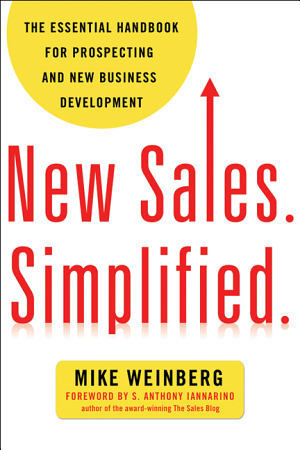
Talk to New Sales. Simplified. like its author wrote you back.
Get the ideas that fit your life — not generic summaries.
- Chat with the book
- Audiobook-style main ideas
- Adapts to your life and goals
- Helps you take action
New Sales. Simplified., in detail
New Sales. Simplified. is Mike Weinberg's argument that most salespeople fail at new business development not because of bad technique but because of confused priorities. Weinberg, a sales consultant who spent years diagnosing why companies' new-business efforts stalled, opens with a list of "reasons salespeople don't prospect" — ranging from being too busy managing existing accounts to the false comfort of social media engagement — and spends the rest of the book dismantling each excuse.
The book's central contribution is the concept of the "sales story." Weinberg argues that most salespeople cannot clearly articulate why a prospect should switch to them from whatever they're using today. They can describe features and throw around industry jargon, but they can't tell a compelling, differentiated story about the problem they solve and the result the prospect gets. He walks through how to construct this story: identify who the ideal customer is, what their problem looks like, what your solution does that alternatives don't, and what a successful outcome looks like. The story has to be short enough to use on a cold call and rich enough to hold a room.
The middle of the book covers account targeting and the mechanics of outbound prospecting — identifying the right companies, the right contacts, and the right timing. Weinberg is direct about the phone: he believes it is still the highest-leverage prospecting tool, and that salespeople who have abandoned it for email and LinkedIn are leaving significant opportunities on the table. He also addresses the sales manager's role, arguing that managers who protect their top producers from prospecting activity are undermining long-term revenue health.
The tone throughout is blunt, practical, and occasionally exasperated. Weinberg has seen too many companies where salespeople are hired to hunt new accounts but drift entirely into account management within a year. His framework is not complex but it requires discipline: target the right accounts, build a sharp story, use the phone, and protect time for outreach. The book works best as a corrective for salespeople or organizations where new-business activity has atrophied quietly over time.
The big ideas
- 1.
Most new-business failures trace back to lack of a compelling sales story, not lack of skill. If you can't say why a prospect should switch to you, no technique will save the call.
- 2.
Target a focused list of strategic accounts. Trying to prospect everyone usually means you prospect no one well.
- 3.
The phone is still the highest-leverage prospecting tool. Abandoning it for email and social media costs opportunities that never show up in the data.
