Talk to Night like its author wrote you back.
Get the ideas that fit your life — not generic summaries.
- Chat with the book
- Audiobook-style main ideas
- Adapts to your life and goals
- Helps you take action
What it argues
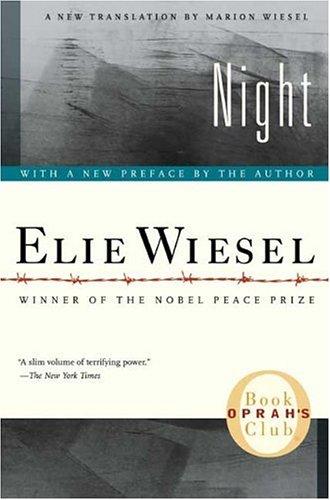
Night is Elie Wiesel's memoir of his deportation from Sighet, a town in Transylvania, to Auschwitz and then Buchenwald in 1944–1945. He was fifteen when the transports began. The book covers roughly a year: the roundup of the Jewish community, the cattle-car journey, arrival and selection at Birkenau, labor in Buna, the death march in winter, and liberation. His mother and younger sister were killed on the day they arrived. His father died of dysentery weeks before the Americans arrived.
The writing is stripped of almost all ornament. Wiesel drafted the original memoir in Yiddish at nearly 900 pages, then cut it to this — originally 178 pages in French — under pressure from the novelist François Mauriac, who helped him find a publisher. The compression is intentional and devastating. There are no psychological cushions, no retrospective interpretations inserted to manage the reader. The events are reported as the fifteen-year-old experienced them, with minimal adult perspective imposed afterward.
What it gets right
- 1.
Survival often required choices that could not be judged from the outside. Wiesel does not moralize about the compromises prisoners made to stay alive.
- 2.
The bureaucratic machinery of the Holocaust was designed to confuse and delay comprehension. Communities disbelieved what was happening until it was too late to act.
- 3.
The father-son relationship becomes the only remaining moral anchor. Wiesel's loyalty to his father and his guilt about the limits of that loyalty are the emotional core of the book.
What it covers
Who wrote it
Elie Wiesel (1928–2016) was a Romanian-born Jewish writer, professor, and activist who survived Auschwitz and Buchenwald. After the war he became a journalist in France, studied at the Sorbonne, and eventually settled in the United States, where he taught at Boston University for decades. In addition to Night, he wrote more than fifty books of memoir, fiction, essays, and drama. He received the Nobel Peace Prize in 1986, with the committee describing him as a "messenger to mankind." He remained an outspoken advocate on questions of genocide, human rights, and the obligation to bear witness.
