Summary
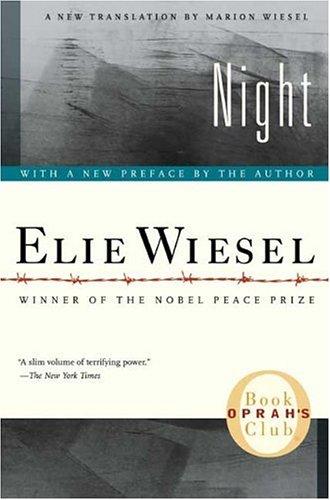
Night is Elie Wiesel's memoir of his deportation from Sighet, a town in Transylvania, to Auschwitz and then Buchenwald in 1944–1945. He was fifteen when the transports began. The book covers roughly a year: the roundup of the Jewish community, the cattle-car journey, arrival and selection at Birkenau, labor in Buna, the death march in winter, and liberation. His mother and younger sister were killed on the day they arrived. His father died of dysentery weeks before the Americans arrived.
The writing is stripped of almost all ornament. Wiesel drafted the original memoir in Yiddish at nearly 900 pages, then cut it to this — originally 178 pages in French — under pressure from the novelist François Mauriac, who helped him find a publisher. The compression is intentional and devastating. There are no psychological cushions, no retrospective interpretations inserted to manage the reader. The events are reported as the fifteen-year-old experienced them, with minimal adult perspective imposed afterward.
The book's philosophical weight lies in the religious crisis at its center. Wiesel was a devout young student of the Talmud and Kabbalah. What happens to faith when what you observe cannot be reconciled with the God you believed in? The famous scene of three prisoners hanged — one of them a child who takes a long time to die — is the pivot. When someone behind Wiesel asks "Where is God now?" and he hears his own inner voice respond "He is hanging here on the gallows," the reader understands what the rest of the book is about.
Night has been translated into thirty languages and is one of the most assigned books in American high schools. This familiarity is a mixed blessing. Read carefully, it resists the comfortable lessons often extracted from it — that suffering ennobles, that resilience is guaranteed, that testimony ensures understanding. Wiesel says plainly that the silence of the world was the other catastrophe, and the book asks whether the reader is part of that silence.
Talk to Night like its author wrote you back.
Get the ideas that fit your life — not generic summaries.
- Chat with the book
- Audiobook-style main ideas
- Adapts to your life and goals
- Helps you take action
Key takeaways
- 1.
Survival often required choices that could not be judged from the outside. Wiesel does not moralize about the compromises prisoners made to stay alive.
- 2.
The bureaucratic machinery of the Holocaust was designed to confuse and delay comprehension. Communities disbelieved what was happening until it was too late to act.
- 3.
The father-son relationship becomes the only remaining moral anchor. Wiesel's loyalty to his father and his guilt about the limits of that loyalty are the emotional core of the book.
- 4.
Faith can be destroyed by what you witness, and Wiesel does not pretend his was restored. The book ends in devastation, not consolation.
- 5.
The silence of the outside world — governments, churches, individuals with information — is part of the event Wiesel is describing, not just background.
- 6.
Memory is not a guarantee of justice. Wiesel writes to witness, but he is realistic that witnessing does not automatically produce the response it should.
- 7.
Dehumanization is a process, not an event. The Nazis spent months stripping identity before the killing. Wiesel tracks this process step by step.
- 8.
The book is short by design. Compression is a moral choice: too many words can aestheticize what should remain unadorned.
Discussion questions
Use these on your own, with a book club, or as chat starters in Superbook.
- 1.
Moshe the Beadle warns the town what is coming after he escapes execution, and no one believes him. What makes people choose not to believe warnings that would require action?
- 2.
Wiesel describes the moment his religious faith broke. Has there been a moment in your own life where you had to reexamine a foundational belief in light of experience?
- 3.
The book does not offer redemption through suffering. How does that absence affect how you read it, compared to narratives that do offer that arc?
- 4.
The SS officer at Auschwitz who tells the prisoners to take off their glasses, give up their possessions, and believe they are being deloused — what does the success of this deception tell you about how human beings process unthinkable information?
- 5.
Wiesel writes that his father's death happened before liberation, and that he felt relief before grief. What does that admission demand of the reader?
- 6.
The book is often taught as a lesson in tolerance or human rights. Is that use of it adequate? What does reading it as testimony rather than lesson change?
- 7.
Wiesel says that silence was the world's response to the Holocaust, and that silence is also a form of complicity. Where in the present do you recognize that dynamic?
- 8.
The night march in winter, where prisoners are shot for falling behind, represents survival as a kind of cruelty to the self. What do you think Wiesel wants the reader to understand about will to live versus death?
- 9.
The book was originally nearly 900 pages and was compressed to this. What do you think was lost in that compression? What was gained?
- 10.
Wiesel received the Nobel Peace Prize in 1986. His acceptance speech argues that neutrality helps the oppressor. Do you agree? What are the costs of that position?
- 11.
How do you read a memoir like this when the events described are beyond your own experience? What are the limits of empathy here?
- 12.
Night is one of the most assigned books in secondary education. Do you think that familiarity has helped or hindered its impact?
Themes
Frequently asked questions
-
Is Night a true story?
Yes. It is Wiesel's memoir of his own deportation and survival. He has described it as testimony rather than autobiography — a distinction that points to its purpose: not to give a complete picture of his life but to record what happened and insist that it be known.
-
How long is Night by Elie Wiesel?
The book runs to about 120 pages in most editions — short enough to read in a single sitting, though most people need to pause. The brevity is intentional: Wiesel cut the original Yiddish manuscript from nearly 900 pages to force the reader to receive the events without cushioning.
-
What is Night mainly about?
The systematic destruction of a Jewish community and a young man's experience of it from the inside. It is also about the destruction of religious faith, the bond between a father and son under extreme pressure, and the silence of the world in the face of mass atrocity.
-
Who should read Night?
Anyone who wants to understand the Holocaust through direct testimony rather than history. It is appropriate for older teenagers and adults. Readers who find documentary history too removed will find Wiesel's first-person account more demanding and more instructive.
-
What does the title Night refer to?
Multiple things simultaneously: the literal nights of the death march and the camp, the darkness into which faith disappeared, and the long historical night of the Holocaust itself. Wiesel uses the image of darkness and silence throughout without explaining it — the accumulation carries the meaning.