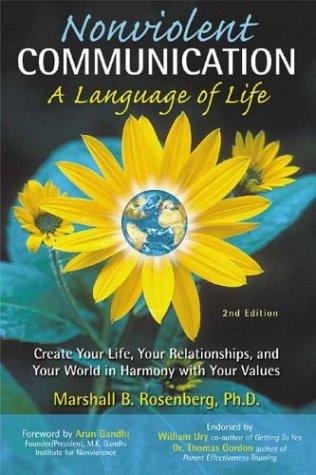
Talk to Nonviolent Communication like its author wrote you back.
Get the ideas that fit your life — not generic summaries.
- Chat with the book
- Audiobook-style main ideas
- Adapts to your life and goals
- Helps you take action
What it argues
Nonviolent Communication is Marshall Rosenberg's framework for communicating in ways that preserve connection and address needs rather than triggering defensiveness. The NVC model distinguishes between language that creates genuine understanding and language that escalates conflict — often without the speaker realizing the difference. Rosenberg, a clinical psychologist who spent decades mediating in conflict zones and organizations, argues that most conflict escalates because people express feelings and needs in ways that sound like criticism, and criticism produces defensiveness rather than response.
The four components of NVC are: observation (describing what you see without evaluation), feeling (naming the emotion you're experiencing rather than describing the behavior of the other person), need (identifying the underlying need connected to the feeling), and request (making a specific, positive, doable request rather than a demand). The framework sounds simple and is genuinely difficult to practice, because most people's default communication patterns mix observation with judgment, feeling with accusation, and request with demand.
What it gets right
- 1.
Most communication that escalates conflict does so because feelings and needs are expressed as criticism or judgment, which produces defensiveness rather than understanding.
- 2.
The four NVC components: observation (without evaluation), feeling (without interpretation), need (underlying the feeling), and request (specific and positive, not a demand).
- 3.
'I feel criticized' is an interpretation; 'I feel hurt' is a feeling. The distinction matters because interpretations assign blame while feelings invite empathy.
What it covers
Who wrote it
Marshall B. Rosenberg (1934–2015) was an American psychologist and founder of the Center for Nonviolent Communication, which he established in 1984. He developed the NVC framework while working as a school desegregation and conflict mediation consultant during the civil rights era, and spent the remainder of his career applying it in conflict zones including Rwanda, Nigeria, Israel, and Palestine. He trained thousands of mediators and coaches and consulted with governments and organizations internationally. Nonviolent Communication has been translated into more than thirty-five languages.
