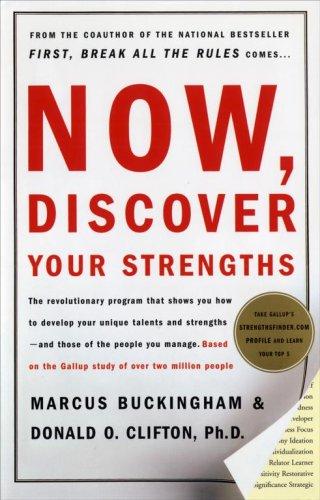
Talk to Now, Discover Your Strengths like its author wrote you back.
Get the ideas that fit your life — not generic summaries.
- Chat with the book
- Audiobook-style main ideas
- Adapts to your life and goals
- Helps you take action
Now, Discover Your Strengths, in detail
Now, Discover Your Strengths is Marcus Buckingham and Donald Clifton's argument that most organizations and individuals invest the majority of their development energy in the wrong place — fixing weaknesses rather than amplifying strengths. The book is anchored by the StrengthsFinder assessment, a web-based tool developed by Gallup that identifies a person's top five talent themes from a list of thirty-four.
The core premise is that strengths are not just things you're good at. They're activities that energize you, that you find yourself gravitating toward naturally, and that you perform in a way that feels almost effortless — even when they're hard. The distinction between talent, knowledge, and skill is central: talent is the natural recurring patterns of thought, feeling, and behavior you're born with; skill and knowledge can be developed, but you can only achieve true strength by building on genuine talent.
The book argues that the most productive development strategy — for individuals and for organizations — is to identify where people have the most natural talent and invest heavily there, rather than working to bring weaknesses up to average. This means managers who understand each person's top themes will get more out of them by creating roles and responsibilities that play to those themes. It also means organizations that insist on well-roundedness are systematically suppressing their best performers.
The StrengthsFinder assessment itself is the practical core of the book. Each theme — Achiever, Activator, Adaptability, Analytical, Arranger, and so on — is described in detail, and the book provides practical suggestions for applying each theme at work. The combination of a concrete assessment tool with management prescriptions made this an influential framework in HR and talent development, even for readers who were skeptical of the underlying Gallup research.
The big ideas
- 1.
Strengths are activities that energize you and produce consistent, near-perfect performance. They're built on natural talent — recurring patterns of thought, feeling, and behavior — not just practice.
- 2.
Most organizations spend the majority of development energy on fixing weaknesses, which produces mediocrity at best. Investing in strengths produces excellence.
- 3.
The thirty-four talent themes are the building blocks of strength. Each person's unique combination of top themes is more useful for predicting performance than job history or credentials.
