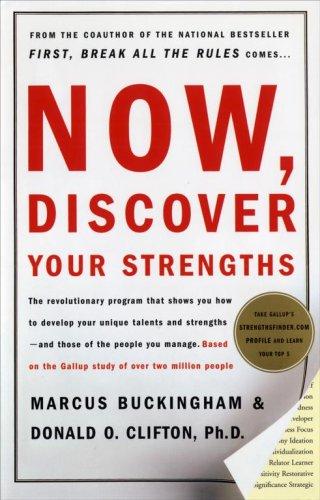
Now, Discover Your Strengths by Marcus Buckingham and Donald O. Clifton is a 2001 business book about strengths, talent development, self-awareness. Strengths are activities that energize you and produce consistent, near-perfect performance. They're built on natural talent — recurring patterns of thought, feeling, and behavior — not just practice.
Summary
Now, Discover Your Strengths is Marcus Buckingham and Donald Clifton's argument that most organizations and individuals invest the majority of their development energy in the wrong place — fixing weaknesses rather than amplifying strengths. The book is anchored by the StrengthsFinder assessment, a web-based tool developed by Gallup that identifies a person's top five talent themes from a list of thirty-four.
The core premise is that strengths are not just things you're good at. They're activities that energize you, that you find yourself gravitating toward naturally, and that you perform in a way that feels almost effortless — even when they're hard. The distinction between talent, knowledge, and skill is central: talent is the natural recurring patterns of thought, feeling, and behavior you're born with; skill and knowledge can be developed, but you can only achieve true strength by building on genuine talent.
The book argues that the most productive development strategy — for individuals and for organizations — is to identify where people have the most natural talent and invest heavily there, rather than working to bring weaknesses up to average. This means managers who understand each person's top themes will get more out of them by creating roles and responsibilities that play to those themes. It also means organizations that insist on well-roundedness are systematically suppressing their best performers.
The StrengthsFinder assessment itself is the practical core of the book. Each theme — Achiever, Activator, Adaptability, Analytical, Arranger, and so on — is described in detail, and the book provides practical suggestions for applying each theme at work. The combination of a concrete assessment tool with management prescriptions made this an influential framework in HR and talent development, even for readers who were skeptical of the underlying Gallup research.
Talk to Now, Discover Your Strengths like its author wrote you back.
Get the ideas that fit your life — not generic summaries.
- Chat with the book
- Audiobook-style main ideas
- Adapts to your life and goals
- Helps you take action
Key takeaways
- 1.
Strengths are activities that energize you and produce consistent, near-perfect performance. They're built on natural talent — recurring patterns of thought, feeling, and behavior — not just practice.
- 2.
Most organizations spend the majority of development energy on fixing weaknesses, which produces mediocrity at best. Investing in strengths produces excellence.
- 3.
The thirty-four talent themes are the building blocks of strength. Each person's unique combination of top themes is more useful for predicting performance than job history or credentials.
- 4.
Talent + Knowledge + Skill = Strength. You can build knowledge and skill through practice, but they only produce a true strength when applied to genuine underlying talent.
- 5.
Managers who understand their direct reports' talent themes can design roles, assign projects, and set expectations in ways that produce consistently better outcomes than role descriptions alone.
- 6.
The instinct to fill every weakness rather than staff around them is expensive. The best organizations build teams where members' strengths are complementary rather than identical.
- 7.
You can't manage all thirty-four themes with the same approach. What motivates someone high in Achiever is different from what motivates someone high in Relator — and pretending otherwise wastes both their time and yours.
- 8.
Career growth built on genuine strengths is faster and more satisfying than career growth built on becoming well-rounded. The evidence from Gallup's management database supports this consistently.
Discussion questions
Use these on your own, with a book club, or as chat starters in Superbook. Book club version, ready to copy or print →
- 1.
What are your top five StrengthsFinder themes? If you've taken the assessment, do the themes feel accurate? If you haven't, which themes on the list do you most recognize in yourself?
- 2.
Buckingham argues that weaknesses should be managed, not developed. What's a weakness you've spent significant time trying to fix? What would have happened if you'd spent that time on a strength instead?
- 3.
Think about the last role you held where you were performing at your best. Which of your strengths were being used most heavily?
- 4.
What's a task or responsibility in your current role that consistently drains you? Does understanding strengths language give you a way to talk about why?
- 5.
If you managed a team, how much do you know about each person's natural talent themes? How would knowing more change how you assign work?
- 6.
The book challenges the well-roundedness ideal. When is being well-rounded genuinely valuable, and when is it an excuse for not going deep in anything?
- 7.
Where on your team are people in roles that don't fit their strengths? What's the evidence that the fit is off?
- 8.
What's the difference between a skill you've developed and a true strength? Can you name one of each from your own experience?
- 9.
Buckingham says strengths energize rather than deplete. What activity in your work week feels like it gives you energy rather than takes it? What does that suggest about your talent themes?
- 10.
How do the strengths frameworks in this book sit alongside your organization's performance review process? Do they complement it, conflict with it, or get ignored entirely?
- 11.
What would your team look like if it were assembled explicitly for complementary strength profiles rather than for identical competency requirements?
Themes
Frequently asked questions
-
Do I need to take the StrengthsFinder assessment to get value from this book?
No, but the assessment significantly increases the book's usefulness. The themes are described in enough detail to self-identify your dominant ones, but the assessment produces a more precise and often surprising result. The book includes a code for the online assessment.
-
How long does it take to read Now, Discover Your Strengths?
Around four to five hours for the 260-page book plus the assessment time. The assessment itself takes about thirty-five minutes. Many readers spend more time with the theme descriptions than with the narrative.
-
Is the StrengthsFinder assessment accurate?
Accuracy is context-dependent. Most people find their top five themes recognizable and useful. The framework's main value is as a shared vocabulary for discussing how people are different from each other, not as a definitive psychological classification. Critics note the reliability of the assessment varies, particularly if respondents aren't honest or self-aware.
-
Who should read Now, Discover Your Strengths?
Anyone thinking about career direction, managers who want a practical tool for understanding their team, and HR professionals evaluating talent frameworks. Also useful for individuals who have been told to 'fix their weaknesses' and want a reframe.
-
What's the most actionable idea in the book?
The 'job sculpting' concept: identify the two or three activities that use your top themes most heavily and find ways to increase the percentage of your time spent on them. Even a shift from 20% to 40% can dramatically change how much you enjoy the job and how well you perform.