Talk to Obedience to Authority like its author wrote you back.
Get the ideas that fit your life — not generic summaries.
- Chat with the book
- Audiobook-style main ideas
- Adapts to your life and goals
- Helps you take action
Obedience to Authority, in detail
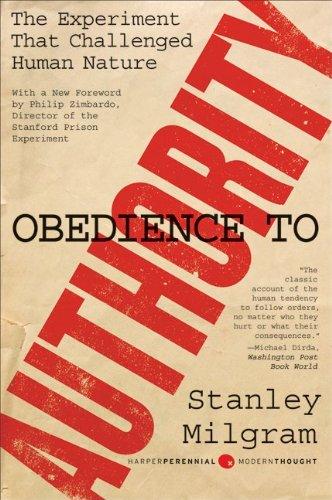
In the early 1960s, Stanley Milgram recruited ordinary people off the street and asked them to administer what they believed were increasingly severe electric shocks to another person on the orders of an experimenter in a lab coat. No shocks were actually delivered — the "victim" was an actor — but the participants didn't know that. What Milgram found disturbed him and has disturbed readers ever since: roughly 65 percent of participants administered the maximum 450-volt shock despite audible screams of pain and demands to stop. They did it because the experimenter told them to.
This book is Milgram's own account of the experiments, their variations, and his interpretation of what they revealed. He ran dozens of variations — changing whether the victim was in the same room, whether the experimenter gave orders in person or by phone, whether participants worked alongside a defiant peer. Each variation produced sharply different obedience rates and together they map the precise conditions under which ordinary people will harm others when an authority figure tells them to. Proximity to the victim reduced obedience; proximity to the authority increased it; seeing a peer defy orders nearly always triggered defiance in the participant.
Milgram's theoretical explanation centers on what he calls the agentic state: when a person enters a legitimate hierarchy, they stop seeing themselves as the author of their own actions and become an instrument of the authority above them. This psychological shift, Milgram argues, is not a sign of cruelty or sadism. Most participants in the maximum-shock condition showed visible distress. They weren't enjoying it. They had simply transferred moral responsibility upward, the same mechanism, Milgram suggests, that allowed ordinary Germans to participate in the Holocaust.
The book remains controversial on ethical grounds — modern psychology would not permit this research to be run today — and some of the obedience figures have been debated in replications. But the core finding has held up in many forms across decades, and the theoretical framework it produced is still the most useful available for understanding how institutions can turn decent people into perpetrators. Milgram's writing is clinical but never cold, and the transcripts of participant reactions to their own behavior are some of the most uncomfortable pages in social science.
The big ideas
- 1.
In Milgram's original study, roughly 65 percent of participants administered what they believed was the maximum 450-volt shock to an unwilling, screaming victim when ordered by an authority figure.
- 2.
The agentic state: when people enter a legitimate authority hierarchy, they tend to see themselves as agents of that authority rather than autonomous moral actors, transferring responsibility upward.
- 3.
Situational factors matter more than personality. Whether or not someone obeyed depended heavily on proximity to the victim, proximity to the experimenter, and whether peers obeyed or defied.
