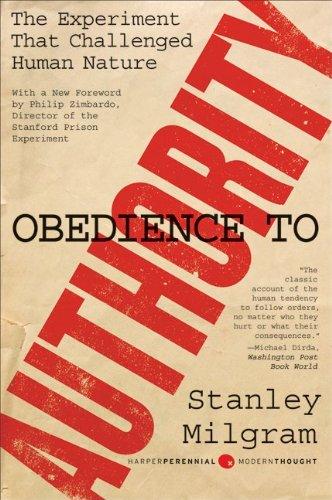
Obedience to Authority by Stanley Milgram is a 1974 psychology book about authority, obedience, social conformity. In Milgram's original study, roughly 65 percent of participants administered what they believed was the maximum 450-volt shock to an unwilling, screaming victim when ordered by an authority figure.
Summary
In the early 1960s, Stanley Milgram recruited ordinary people off the street and asked them to administer what they believed were increasingly severe electric shocks to another person on the orders of an experimenter in a lab coat. No shocks were actually delivered — the "victim" was an actor — but the participants didn't know that. What Milgram found disturbed him and has disturbed readers ever since: roughly 65 percent of participants administered the maximum 450-volt shock despite audible screams of pain and demands to stop. They did it because the experimenter told them to.
This book is Milgram's own account of the experiments, their variations, and his interpretation of what they revealed. He ran dozens of variations — changing whether the victim was in the same room, whether the experimenter gave orders in person or by phone, whether participants worked alongside a defiant peer. Each variation produced sharply different obedience rates and together they map the precise conditions under which ordinary people will harm others when an authority figure tells them to. Proximity to the victim reduced obedience; proximity to the authority increased it; seeing a peer defy orders nearly always triggered defiance in the participant.
Milgram's theoretical explanation centers on what he calls the agentic state: when a person enters a legitimate hierarchy, they stop seeing themselves as the author of their own actions and become an instrument of the authority above them. This psychological shift, Milgram argues, is not a sign of cruelty or sadism. Most participants in the maximum-shock condition showed visible distress. They weren't enjoying it. They had simply transferred moral responsibility upward, the same mechanism, Milgram suggests, that allowed ordinary Germans to participate in the Holocaust.
The book remains controversial on ethical grounds — modern psychology would not permit this research to be run today — and some of the obedience figures have been debated in replications. But the core finding has held up in many forms across decades, and the theoretical framework it produced is still the most useful available for understanding how institutions can turn decent people into perpetrators. Milgram's writing is clinical but never cold, and the transcripts of participant reactions to their own behavior are some of the most uncomfortable pages in social science.
Talk to Obedience to Authority like its author wrote you back.
Get the ideas that fit your life — not generic summaries.
- Chat with the book
- Audiobook-style main ideas
- Adapts to your life and goals
- Helps you take action
Key takeaways
- 1.
In Milgram's original study, roughly 65 percent of participants administered what they believed was the maximum 450-volt shock to an unwilling, screaming victim when ordered by an authority figure.
- 2.
The agentic state: when people enter a legitimate authority hierarchy, they tend to see themselves as agents of that authority rather than autonomous moral actors, transferring responsibility upward.
- 3.
Situational factors matter more than personality. Whether or not someone obeyed depended heavily on proximity to the victim, proximity to the experimenter, and whether peers obeyed or defied.
- 4.
Seeing a peer defy the experimenter was the most effective trigger for participant defiance — more effective than moral argument, time to reflect, or any other variable Milgram tested.
- 5.
Obedience is not sadism. Most high-obedience participants showed visible distress. They harmed others while feeling terrible about it, because they had handed off their moral agency.
- 6.
The experiments illuminate not individual cruelty but institutional dynamics: how ordinary, well-meaning people participate in harmful acts when embedded in legitimate hierarchies.
- 7.
Milgram draws a direct parallel to Holocaust perpetrators — not as an excuse but as an analytical framework for how ordinary individuals become instruments of atrocity.
- 8.
Physical and psychological distance from victims reduces moral inhibition. Bureaucratic structures that separate decision from consequence exploit this fact systematically.
Discussion questions
Use these on your own, with a book club, or as chat starters in Superbook. Book club version, ready to copy or print →
- 1.
Milgram's 65 percent figure is often cited to argue that most people will obey harmful orders. How do you respond to that claim when applied to yourself?
- 2.
What is the agentic state, and can you identify a situation in your own life where you entered it — where you acted on authority rather than your own judgment?
- 3.
The most effective way to break obedience was to see a peer defy the experimenter. What does that imply about how to design institutions or social situations to prevent harm?
- 4.
Milgram's research is widely cited but could not be run today under modern ethics rules. How do you weigh the value of what was learned against the cost to the participants?
- 5.
If physical proximity to a victim dramatically reduces obedience, what does that say about modern forms of harm that operate at a distance — drone strikes, financial instruments, supply chains?
- 6.
Many participants showed acute distress while still obeying. Does visible distress change your moral assessment of what they did?
- 7.
Milgram draws a parallel to the Holocaust. Does that parallel feel like an explanation or an excuse to you? What's the difference?
- 8.
The experimenter's authority came partly from the Yale setting and a lab coat, not from any formal power over participants. What does that say about how authority is constructed?
- 9.
Obedience rates dropped significantly when the experimenter gave orders by phone rather than in person. How does that finding apply to remote work, automated decision-making, or social media moderation?
- 10.
The participants were not selected for cruelty. They were ordinary people. Does that make the findings more or less disturbing to you?
- 11.
What conditions in your current work or life might inadvertently put you in a position of following harmful instructions without questioning them?
- 12.
If you had been a participant, at what point do you think you would have stopped? What would have made the difference?
Themes
Frequently asked questions
-
What did the Milgram experiment prove?
That most ordinary people will inflict serious harm on others when ordered to by an authority figure, even when they believe the harm is real and the victim is protesting. It demonstrated that obedience to authority is a powerful enough force to override individual moral judgment in most people under the right conditions.
-
Is Obedience to Authority still relevant today?
Yes. The mechanisms Milgram identified — the agentic state, authority legitimacy, physical distance from victims — are present in modern institutions, corporate hierarchies, online harm, and political violence. The book reads as urgent as when it was written.
-
Was the Milgram experiment ethical?
By modern standards, no. Participants experienced severe psychological distress and were deceived throughout. Milgram did debrief participants afterward, and most reported they were glad to have taken part, but the experiment could not be replicated under current ethical review guidelines.
-
Who should read this book?
Anyone interested in how ordinary people participate in harmful institutions, including managers, policymakers, military personnel, and anyone trying to understand historical atrocities. It is not comfortable reading but it is important reading.
-
What is the most important finding in the book?
That situational factors predict harmful obedience better than personality does. Milgram showed that by changing the setup — not the people — you could move obedience rates from near zero to 65 percent. Institutions and environments shape behavior more than we want to believe.
Similar books
Thinking, Fast and Slow
Daniel Kahneman
The Lucifer Effect: Understanding How Good People Turn Evil
Philip Zimbardo
Influence: The Psychology of Persuasion
Robert B. Cialdini
Behave: The Biology of Humans at Our Best and Worst
Robert M. Sapolsky
