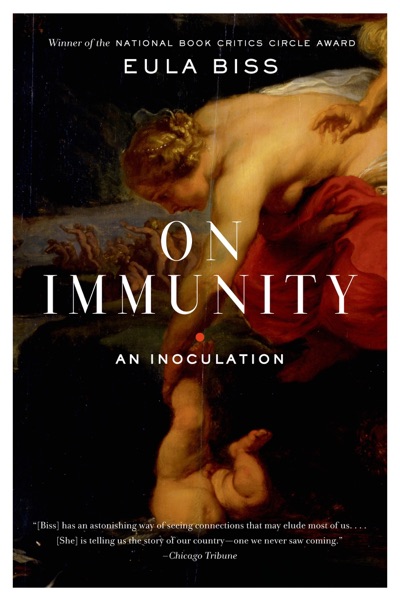
Talk to On Immunity: An Inoculation like its author wrote you back.
Get the ideas that fit your life — not generic summaries.
- Chat with the book
- Audiobook-style main ideas
- Adapts to your life and goals
- Helps you take action
What it argues
Eula Biss wrote On Immunity: An Inoculation in 2014 as an essay collection loosely structured around her experience as a new mother confronting the vaccination question. The book is neither a polemic for vaccines nor a balanced debate text — it is an inquiry into why vaccination became so contested, what the fears that drive vaccine hesitancy actually are, and what those fears reveal about how people think about bodies, risk, nature, and community.
Biss trained as an essayist, not a scientist, and the book reflects that: it moves associatively, drawing on literary sources (Voltaire's Candide, Bram Stoker's Dracula, Susan Sontag's Illness as Metaphor), historical case studies (the history of smallpox vaccination, the mercury controversy, the Tuskegee syphilis study), and her own thinking as a parent. The result is a book that illuminates the emotional logic of anti-vaccine sentiment more clearly than most purely scientific arguments against it.
What it gets right
- 1.
Fear of vaccines is rarely about scientific evidence alone — it is about trust in institutions, and that trust has historical reasons to be conditional, particularly in communities that have experienced medical harm.
- 2.
The ideology of the natural — the assumption that natural substances and processes are inherently safer than engineered ones — is a persistent source of confusion about vaccines and pharmaceutical risk.
- 3.
Herd immunity makes vaccination a community act, not just an individual one. Refusing vaccination for a healthy child who could tolerate it shifts risk onto children who cannot be vaccinated.
What it covers
Who wrote it
Eula Biss is an American essayist and the author of three books: The Balloonists (2002), Notes from No Man's Land (2009), and On Immunity: An Inoculation (2014). Notes from No Man's Land won the Graywolf Press Nonfiction Prize and the National Book Critics Circle Award for criticism. Biss teaches at Northwestern University and has been a fellow at the Radcliffe Institute for Advanced Study at Harvard. Her essays have appeared in Harper's Magazine, The Believer, and The New York Times Magazine.
