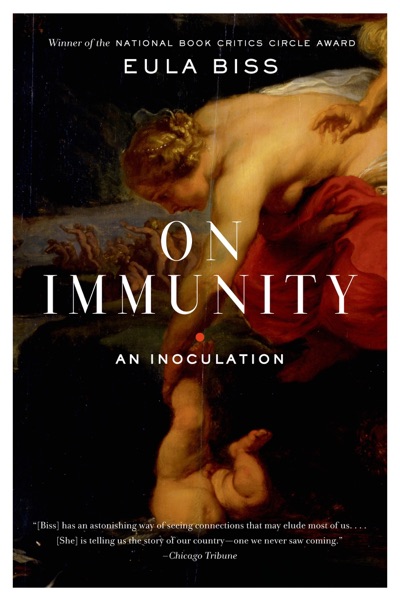
On Immunity: An Inoculation by Eula Biss is a 2014 science book about vaccination and public health, fear and risk perception, motherhood. Fear of vaccines is rarely about scientific evidence alone — it is about trust in institutions, and that trust has historical reasons to be conditional, particularly in communities that have experienced medical harm.
Summary
Eula Biss wrote On Immunity: An Inoculation in 2014 as an essay collection loosely structured around her experience as a new mother confronting the vaccination question. The book is neither a polemic for vaccines nor a balanced debate text — it is an inquiry into why vaccination became so contested, what the fears that drive vaccine hesitancy actually are, and what those fears reveal about how people think about bodies, risk, nature, and community.
Biss trained as an essayist, not a scientist, and the book reflects that: it moves associatively, drawing on literary sources (Voltaire's Candide, Bram Stoker's Dracula, Susan Sontag's Illness as Metaphor), historical case studies (the history of smallpox vaccination, the mercury controversy, the Tuskegee syphilis study), and her own thinking as a parent. The result is a book that illuminates the emotional logic of anti-vaccine sentiment more clearly than most purely scientific arguments against it.
The core insight running through the book is that fear of vaccines is rarely about the science — it's about trust, and specifically about which bodies and which institutions are trusted with which decisions. The historical record of medical harm to marginalized communities, the genuine paternalism of public health messaging, and the cultural ideology that treats nature as inherently safer than intervention all contribute to a situation where the scientific consensus becomes difficult to communicate to people who have rational reasons not to trust institutions.
Biss also examines the concept of herd immunity directly — the idea that vaccination is an act of community as much as individual protection. She argues that thinking of your own body as a private space, separate from the bodies around it, is a fantasy that immunology makes visible. Bodies are porous, interconnected, and what happens in one affects others. The book's title, An Inoculation, is a double meaning: it is a book about vaccines, and it is also Biss's attempt to inoculate herself and her readers against the anxieties that drive unreasonable fear.
Talk to On Immunity: An Inoculation like its author wrote you back.
Get the ideas that fit your life — not generic summaries.
- Chat with the book
- Audiobook-style main ideas
- Adapts to your life and goals
- Helps you take action
Key takeaways
- 1.
Fear of vaccines is rarely about scientific evidence alone — it is about trust in institutions, and that trust has historical reasons to be conditional, particularly in communities that have experienced medical harm.
- 2.
The ideology of the natural — the assumption that natural substances and processes are inherently safer than engineered ones — is a persistent source of confusion about vaccines and pharmaceutical risk.
- 3.
Herd immunity makes vaccination a community act, not just an individual one. Refusing vaccination for a healthy child who could tolerate it shifts risk onto children who cannot be vaccinated.
- 4.
Biss traces vaccine skepticism to sources including Voltaire, Romanticism, and the cultural legacy of Frankenstein — a deep vein of anxiety about artificial interference with natural processes.
- 5.
The history of public health is not neutral: the Tuskegee study and other episodes of medical harm to marginalized populations are part of the context in which vaccination debates happen, and dismissing them is both historically inaccurate and tactically counterproductive.
- 6.
Susan Sontag's analysis of illness metaphors — cancer as invasion, AIDS as punishment — applies directly to the rhetoric around vaccination and the immune system.
- 7.
The concept of the porous, interconnected body is the book's central image: individual bodily autonomy is real but incomplete, because all bodies are in contact with and affected by other bodies.
Discussion questions
Use these on your own, with a book club, or as chat starters in Superbook. Book club version, ready to copy or print →
- 1.
Biss argues that fear of vaccines is rooted in distrust of institutions, not ignorance of science. Does that framing change how you think about effective public health communication?
- 2.
She traces vaccine skepticism to a long cultural tradition of suspecting artificial intervention in natural processes. Is that tradition ever a useful check? When does it become counterproductive?
- 3.
The concept of herd immunity frames vaccination as a social act. Does thinking of it that way change how you feel about vaccine refusal? Does it change the ethics?
- 4.
Biss is honest about her own ambivalence as a new mother, even as she ultimately follows the vaccine schedule. Does that ambivalence make the book more or less persuasive?
- 5.
The Tuskegee study and other episodes of medical harm are invoked to explain why distrust of public health institutions is historically grounded. Does that explanation require endorsing the conclusions drawn from it?
- 6.
She reads Bram Stoker's Dracula as a cultural text about contamination anxiety. Does the literary approach to a scientific question work for you? What does it add that a purely scientific argument wouldn't?
- 7.
The book was published in 2014. How has the landscape of vaccine hesitancy changed since then, and how well do Biss's arguments address the current form of the debate?
- 8.
Biss treats the body as porous and interconnected — inherently social, not private. What are the implications of that view for how we think about individual rights versus collective welfare in public health?
- 9.
She is careful to avoid condescension toward parents who hesitate. Is that care fully achieved in the book? Or does the essay form create a distance from the people she's writing about?
- 10.
Herd immunity requires a high threshold of vaccination in a population. At what point, if any, does the state have legitimate authority to mandate vaccination? What does Biss's framework suggest?
- 11.
The book is about vaccines but also about motherhood, risk, and the experience of new parenthood. How does framing a public health question through a personal experience change the argument?
Themes
Frequently asked questions
-
What is On Immunity about?
It is an essay collection exploring the history, science, and cultural meaning of vaccination through the lens of new motherhood. Biss is less interested in debunking anti-vaccine arguments than in understanding the fears and distrusts that drive them, and in examining what vaccination asks of us as members of a community.
-
Is On Immunity a pro-vaccine book?
Yes, but not a polemical one. Biss follows the vaccine schedule for her child and argues for the importance of herd immunity, but the book's method is to understand vaccine hesitancy rather than attack it, which makes it more persuasive and more substantive than most writing on the topic.
-
How long does it take to read On Immunity?
Three to four hours. The essays are short and can be read in any order, though the book has a cumulative argument that benefits from reading it through. It is accessible to non-scientists and reads more like literary nonfiction than popular science.
-
Who should read On Immunity?
Anyone trying to understand the vaccine debate, healthcare workers and public health communicators, parents with questions about the vaccine schedule, and readers interested in the intersection of science, culture, and personal decision-making. It is also a good read for anyone interested in contemporary American essayism.
-
What is the most important idea in On Immunity?
That bodily autonomy and community interconnection are not opposites but coexist in every decision about vaccination. The concept of herd immunity makes visible something that is true biologically and morally: what you do with your own body has consequences for the bodies of people around you, particularly those too young or too ill to be vaccinated themselves.