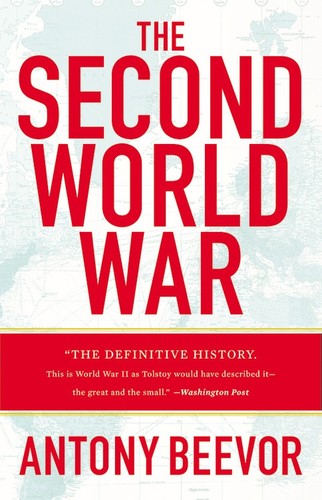
Talk to The Second World War like its author wrote you back.
Get the ideas that fit your life — not generic summaries.
- Chat with the book
- Audiobook-style main ideas
- Adapts to your life and goals
- Helps you take action
What it argues
Antony Beevor's The Second World War, published in 2012, is a single-volume narrative history of the entire conflict from 1939 to 1945. Beevor is best known for his campaign histories — Stalingrad, Berlin, D-Day — and this book draws on that research while attempting something more ambitious: a connected account of all theaters, all major powers, and the experience of both soldiers and civilians across six years of global war.
The book's strength is breadth without superficiality. Beevor moves between the Eastern Front, the Pacific, North Africa, and Western Europe with sufficient detail to give each theater its own texture. He is especially good on the interaction between political decisions and military outcomes — how Churchill's strategic priorities clashed with American ones, how Stalin's interference cost the Red Army hundreds of thousands of lives, how Japanese military culture created a catastrophic disconnect between ambition and logistics.
What it gets right
- 1.
World War II was not a single conflict but a series of overlapping wars — in Europe, the Pacific, North Africa, and Asia — each with its own logic and turning points.
- 2.
Stalin's political control of Soviet military operations, particularly in the early years, cost the Red Army catastrophically in lives and strategic positioning.
- 3.
Allied victory was not inevitable. The interaction of American industrial capacity, Soviet manpower, and British strategic persistence created a coalition that could outlast the Axis — but any of several earlier decisions could have broken it.
What it covers
Who wrote it
Antony Beevor is a British historian and former British Army officer who has written extensively on the Second World War. His campaign histories — Stalingrad (1998), Berlin (2002), and D-Day (2009) — were international bestsellers and set a standard for combining archival research with narrative accessibility. He studied at Sandhurst and served in the 11th Hussars before turning to writing. His work draws on archives in Russia, Germany, the United States, and the United Kingdom, and he has received numerous literary prizes including the Wolfson History Prize.
