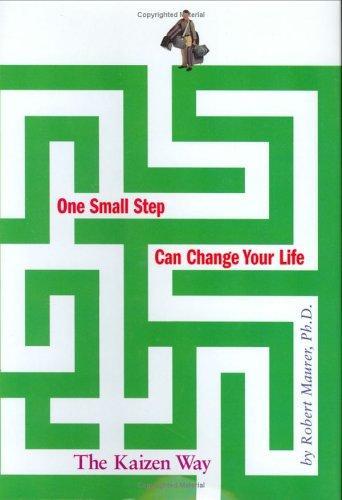
Talk to One Small Step Can Change Your Life like its author wrote you back.
Get the ideas that fit your life — not generic summaries.
- Chat with the book
- Audiobook-style main ideas
- Adapts to your life and goals
- Helps you take action
What it argues
Robert Maurer's book is built around a single Japanese concept: kaizen, the practice of continuous improvement through very small steps. Where most Western approaches to change favor bold goals and dramatic action, kaizen works by making changes so small that the brain's fear response — centered in the amygdala — never activates. The central insight is that big goals produce resistance; tiny actions bypass it.
Maurer is a clinical psychologist at UCLA's School of Medicine who has used kaizen principles with patients navigating significant life changes — quitting smoking, losing weight, starting an exercise habit after years of sedentary living. The neuroscience he invokes is straightforward: the amygdala responds to novelty and challenge by diverting cognitive resources away from the cortex. Actions so small they feel trivial don't register as threats, which keeps the cortex — the seat of problem-solving and creative thinking — available for the actual work of change.
What it gets right
- 1.
The amygdala treats big goals as threats and activates the fight-or-flight response, which explains why motivation collapses when people try to change too much too fast.
- 2.
Very small actions bypass the brain's threat-detection system entirely. Changes so modest they feel trivial don't trigger resistance.
- 3.
Asking small questions — rather than large, pressure-laden ones — stimulates creative thinking without defensive shutdown.
What it covers
Who wrote it
Robert Maurer is a clinical psychologist on the faculty of the UCLA School of Medicine and the author of several books on kaizen and continuous improvement. He has applied kaizen principles in clinical settings with patients working on behavioral change and in organizational consulting. His work draws on the Japanese manufacturing philosophy of small continuous improvement and translates it into a framework for personal and professional change. He is also the author of Mastering Fear and conducts workshops and lectures for healthcare and business audiences.
