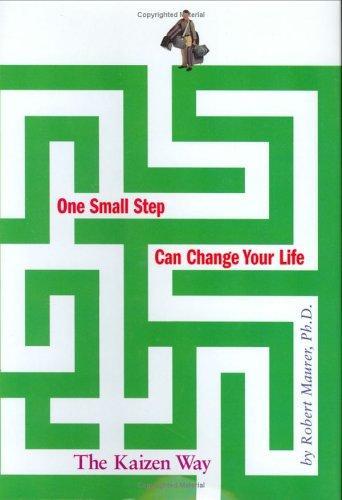
One Small Step Can Change Your Life by Robert Maurer is a 2004 self-help book about kaizen, incremental change, habits. The amygdala treats big goals as threats and activates the fight-or-flight response, which explains why motivation collapses when people try to change too much too fast.
Summary
Robert Maurer's book is built around a single Japanese concept: kaizen, the practice of continuous improvement through very small steps. Where most Western approaches to change favor bold goals and dramatic action, kaizen works by making changes so small that the brain's fear response — centered in the amygdala — never activates. The central insight is that big goals produce resistance; tiny actions bypass it.
Maurer is a clinical psychologist at UCLA's School of Medicine who has used kaizen principles with patients navigating significant life changes — quitting smoking, losing weight, starting an exercise habit after years of sedentary living. The neuroscience he invokes is straightforward: the amygdala responds to novelty and challenge by diverting cognitive resources away from the cortex. Actions so small they feel trivial don't register as threats, which keeps the cortex — the seat of problem-solving and creative thinking — available for the actual work of change.
The toolkit includes asking small questions (not "how do I get fit?" but "what is one small thing I could do today?"), taking small actions (march in place during one commercial break; floss one tooth), recognizing small moments, and bestowing small rewards. Maurer also covers small solutions for organizations, where the same kaizen logic has been applied in manufacturing and healthcare to produce consistent incremental improvement without the disruption of large-scale initiatives.
The book is lean and warm, written by a clinician who has seen these tools work with resistant patients. The examples are vivid and specific. The weakness is the same as most kaizen-influenced writing: the method is most powerful for initiating change and building momentum, but it says less about how to scale from tiny actions to significant habits once the initial resistance is overcome. For readers paralyzed by the gap between current and desired state, Maurer offers an unusually practical bridge.
Talk to One Small Step Can Change Your Life like its author wrote you back.
Get the ideas that fit your life — not generic summaries.
- Chat with the book
- Audiobook-style main ideas
- Adapts to your life and goals
- Helps you take action
Key takeaways
- 1.
The amygdala treats big goals as threats and activates the fight-or-flight response, which explains why motivation collapses when people try to change too much too fast.
- 2.
Very small actions bypass the brain's threat-detection system entirely. Changes so modest they feel trivial don't trigger resistance.
- 3.
Asking small questions — rather than large, pressure-laden ones — stimulates creative thinking without defensive shutdown.
- 4.
Kaizen works cumulatively. Small actions create neural pathways that make slightly larger actions feel safe over time.
- 5.
The method is most useful for initiating a change that has repeatedly stalled due to fear, overwhelm, or previous failure.
- 6.
Small moments of recognition — noticing and naming small progress — are more motivating than waiting for large results.
- 7.
Organizations use kaizen to improve processes without the disruption of large change initiatives. The same logic applies to personal change.
- 8.
The alternative to kaizen — innovation-style leaps — works sometimes but fails often because it requires sustained motivation that most people can't maintain across the full time to an outcome.
Discussion questions
Use these on your own, with a book club, or as chat starters in Superbook. Book club version, ready to copy or print →
- 1.
Maurer argues that most change attempts fail because they're too large for the brain's threat-detection system to accept. Can you identify a goal you've tried and failed to start where this explanation fits?
- 2.
What's the smallest possible version of a change you currently want to make — small enough that doing it today feels genuinely easy?
- 3.
The amygdala responds to novelty and challenge. How does that mechanism explain procrastination more precisely than 'lack of discipline'?
- 4.
Maurer works with clinical patients who have strong resistance to change. How applicable is his approach to people who are motivated but inconsistent rather than resistant?
- 5.
He distinguishes between kaizen (small continuous improvement) and innovation (large leaps). Which mode does your work or personal life favor, and which do you think you need more of?
- 6.
The book is short and the ideas are simple. Does simplicity make you trust the method more or less?
- 7.
Which of the kaizen tools — small questions, small actions, small rewards, small moments — feels most useful for something you're currently working on?
- 8.
Have you ever started something with a very small action and found it naturally grew into a larger practice? What did that progression look like?
- 9.
Maurer's examples include patients dealing with weight, addiction, and chronic illness. Does applying the same framework to those problems and to routine productivity goals make sense to you?
- 10.
The book was published in 2004. How does it hold up against more recent habits literature, and what does it add that books like Atomic Habits don't cover?
- 11.
What's the gap between where you are and where you want to be in some area of life? What would the first genuinely small action toward closing that gap look like?
Themes
Frequently asked questions
-
Is One Small Step Can Change Your Life worth reading?
Yes, particularly if you've tried and failed to initiate a change repeatedly. The kaizen framework is genuinely different from most self-help advice in its emphasis on starting absurdly small. The book is short enough to read in one sitting.
-
How long does it take to read this book?
Under three hours. The book is around 180 pages and reads quickly. The examples are concrete and the argument is simple, so it doesn't demand much re-reading.
-
What is kaizen?
A Japanese concept meaning continuous improvement through small, incremental steps. In manufacturing it's applied to process efficiency; Maurer applies it to personal behavior change, arguing that tiny actions bypass the brain's resistance to change.
-
Who should read this book?
People who feel paralyzed by the gap between where they are and where they want to be, particularly those who have tried bigger approaches and found them unsustainable. Also useful for coaches and clinicians working with clients who resist change.
-
How does this compare to Atomic Habits?
Atomic Habits provides a more comprehensive framework with more scientific depth. One Small Step is narrower — focused specifically on starting very small to overcome resistance — and shorter. They complement each other well; Maurer is better on initiation, Clear is better on maintenance and system design.