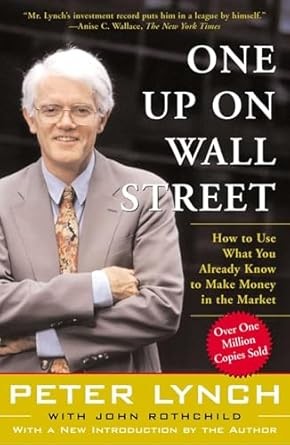
Talk to One Up On Wall Street like its author wrote you back.
Get the ideas that fit your life — not generic summaries.
- Chat with the book
- Audiobook-style main ideas
- Adapts to your life and goals
- Helps you take action
One Up On Wall Street, in detail
One Up On Wall Street is Peter Lynch's argument that ordinary investors have a genuine advantage over professional fund managers, and that the key to beating the market is paying attention to what you already know. Lynch ran the Fidelity Magellan Fund from 1977 to 1990, compounding at roughly 29 percent annually, one of the best long-run track records in mutual fund history. The book is his explanation of how he thought about stocks and why amateur investors are often better positioned than they realize.
The core idea is that individual investors encounter potential investments in everyday life before Wall Street analysts do. You shop at a chain restaurant before institutional investors notice its expansion. You see your kids wearing the same brand. You notice that a niche product at your company is selling unexpectedly well. Lynch calls this "investing in what you know," but he is careful about what he means: knowing a company makes a product you like is only the starting point. What follows is actual research — reading annual reports, checking balance sheets, understanding why the company earns money and whether it can keep doing so.
Lynch categorizes stocks into six types: slow growers, stalwarts, fast growers, cyclicals, turnarounds, and asset plays. Each type requires a different holding strategy and has different warning signs. A fast grower is exciting but dangerous if it expands too quickly into markets it doesn't understand. A cyclical that looks cheap on earnings may be near a peak. Knowing which type of company you own clarifies when to buy more and when to sell. Lynch gives specific financial metrics to monitor: the price-to-earnings growth ratio, cash position, debt load, and inventory levels.
The book is candid about losses. Lynch discusses his own bad picks alongside his successes and argues that a portfolio in which six of ten stocks work out can still compound well if the winners are held long enough. The key discipline is not avoiding mistakes but resizing them: don't put too much in any single speculative idea, cut losers that have deteriorating fundamentals, and hold winners whose story remains intact. The conversational tone and humor make the stock analysis feel approachable, though the underlying research discipline Lynch describes is more demanding than the book's casual style suggests.
The big ideas
- 1.
Individual investors often encounter great stocks in daily life before professional analysts do. The consumer who notices a new product trend has a real informational edge.
- 2.
Knowing a product you like is just the beginning. Real investing requires checking the financials to see whether the company behind it is actually worth owning.
- 3.
Lynch's six stock categories — slow growers, stalwarts, fast growers, cyclicals, turnarounds, asset plays — each require different expectations and exit criteria.
