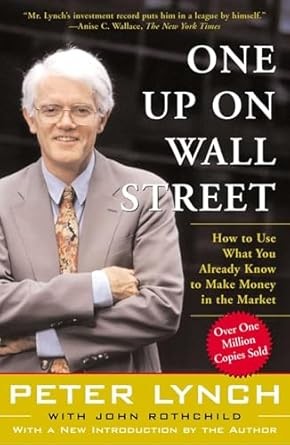
One Up On Wall Street by Peter Lynch is a 1989 economics book about stock picking, individual investing, growth investing. Individual investors often encounter great stocks in daily life before professional analysts do. The consumer who notices a new product trend has a real informational edge.
Summary
One Up On Wall Street is Peter Lynch's argument that ordinary investors have a genuine advantage over professional fund managers, and that the key to beating the market is paying attention to what you already know. Lynch ran the Fidelity Magellan Fund from 1977 to 1990, compounding at roughly 29 percent annually, one of the best long-run track records in mutual fund history. The book is his explanation of how he thought about stocks and why amateur investors are often better positioned than they realize.
The core idea is that individual investors encounter potential investments in everyday life before Wall Street analysts do. You shop at a chain restaurant before institutional investors notice its expansion. You see your kids wearing the same brand. You notice that a niche product at your company is selling unexpectedly well. Lynch calls this "investing in what you know," but he is careful about what he means: knowing a company makes a product you like is only the starting point. What follows is actual research — reading annual reports, checking balance sheets, understanding why the company earns money and whether it can keep doing so.
Lynch categorizes stocks into six types: slow growers, stalwarts, fast growers, cyclicals, turnarounds, and asset plays. Each type requires a different holding strategy and has different warning signs. A fast grower is exciting but dangerous if it expands too quickly into markets it doesn't understand. A cyclical that looks cheap on earnings may be near a peak. Knowing which type of company you own clarifies when to buy more and when to sell. Lynch gives specific financial metrics to monitor: the price-to-earnings growth ratio, cash position, debt load, and inventory levels.
The book is candid about losses. Lynch discusses his own bad picks alongside his successes and argues that a portfolio in which six of ten stocks work out can still compound well if the winners are held long enough. The key discipline is not avoiding mistakes but resizing them: don't put too much in any single speculative idea, cut losers that have deteriorating fundamentals, and hold winners whose story remains intact. The conversational tone and humor make the stock analysis feel approachable, though the underlying research discipline Lynch describes is more demanding than the book's casual style suggests.
Talk to One Up On Wall Street like its author wrote you back.
Get the ideas that fit your life — not generic summaries.
- Chat with the book
- Audiobook-style main ideas
- Adapts to your life and goals
- Helps you take action
Key takeaways
- 1.
Individual investors often encounter great stocks in daily life before professional analysts do. The consumer who notices a new product trend has a real informational edge.
- 2.
Knowing a product you like is just the beginning. Real investing requires checking the financials to see whether the company behind it is actually worth owning.
- 3.
Lynch's six stock categories — slow growers, stalwarts, fast growers, cyclicals, turnarounds, asset plays — each require different expectations and exit criteria.
- 4.
The PEG ratio (price-to-earnings divided by growth rate) is a quick filter for value. A PEG below 1 often indicates an attractively priced growth stock.
- 5.
Hold winners that retain strong fundamentals. The biggest mistake is selling too early because a stock has doubled, when the underlying story has not changed.
- 6.
Avoid the 'diworsification' trap: companies that expand into businesses they don't understand, diluting returns and distracting management.
- 7.
Check the balance sheet before you buy. A company with significant debt is far more vulnerable to a downturn than one sitting on cash.
- 8.
Most professional fund managers underperform the index because they are constrained by institutional pressures — size limits, career risk, peer benchmarking. Individual investors face none of these.
Discussion questions
Use these on your own, with a book club, or as chat starters in Superbook. Book club version, ready to copy or print →
- 1.
Lynch argues individual investors have an informational edge through everyday life. What product, service, or company have you noticed recently that a professional analyst might not be paying attention to?
- 2.
Have you ever acted on a consumer observation as an investment thesis? How did the idea look when you actually examined the company's financials?
- 3.
Lynch distinguishes between a company you like and a company worth owning. Where do most people stop in that process, and why?
- 4.
Which of Lynch's six stock categories does most of your portfolio fit into? Does that match the kind of returns and risks you actually want?
- 5.
Lynch says the biggest mistake investors make is selling too early. Have you ever sold a winner quickly, then watched it continue to rise? What drove the decision to sell?
- 6.
The concept of 'diworsification' — a company expanding into businesses it doesn't understand — can also apply to an individual investor's portfolio. Are there holdings in your portfolio you don't actually understand?
- 7.
Lynch is candid about bad picks. What was your worst investment decision, and what did the story look like before the loss? Was the mistake visible in the fundamentals?
- 8.
Lynch describes doing research in shoe leather — visiting stores, talking to employees, reading trade publications. How much time do you actually spend researching a stock before buying?
- 9.
How do you know when to sell? Lynch's framework is: sell when the original reason you bought no longer holds. What is your actual decision rule?
- 10.
Lynch's approach assumes you can do meaningful financial analysis as an individual investor. Do you have the skills and time to do that, or is indexing the more realistic path for you?
- 11.
The book came out in 1989. Are the categories and analytical frameworks Lynch describes still applicable to technology-driven companies that were barely imaginable then?
- 12.
Lynch ran the Magellan Fund for thirteen years. What would it take to maintain the analytical discipline he describes for a decade, not just through one good run?
Themes
Frequently asked questions
-
Is One Up On Wall Street good for beginners?
Yes, with a caveat. The conversational style and consumer-observation framework make it accessible, and Lynch explains financial concepts without jargon. But readers should understand that the research discipline Lynch describes — reading annual reports, analyzing balance sheets, monitoring PEG ratios — requires real effort. The book is a better starting point for engaged investors than passive ones.
-
What is the main idea of One Up On Wall Street?
That individual investors have informational advantages over professionals through everyday consumer experience, and that paying attention to what you observe in your own life can generate investment ideas before Wall Street notices them. The caveat is that observation is just the beginning: the investing still requires real financial analysis.
-
How does Peter Lynch pick stocks?
Lynch starts with direct consumer or professional observation, then classifies the company into one of six categories (slow grower, stalwart, fast grower, cyclical, turnaround, asset play). He checks key financial metrics — earnings growth rate, PEG ratio, debt levels, cash position, inventory trends — and forms a simple narrative about why the company will do well. He holds as long as the story holds.
-
Is One Up On Wall Street still relevant today?
The core principles hold up, though some of Lynch's specific examples and metrics feel dated. The consumer-observation approach is harder to apply to platform technology companies with network-effect economics than it was to retail and manufacturing businesses. The psychological advice — hold winners, don't panic, do your homework — remains sound.
-
What does 'invest in what you know' actually mean?
It means starting your investment research with observations from your own life — products you use, industries you work in, trends you notice before the media does. Lynch is explicit that this is only the starting point, not a sufficient reason to buy. The research that follows is what determines whether the observation translates to a good investment.