Talk to Only the Paranoid Survive like its author wrote you back.
Get the ideas that fit your life — not generic summaries.
- Chat with the book
- Audiobook-style main ideas
- Adapts to your life and goals
- Helps you take action
What it argues
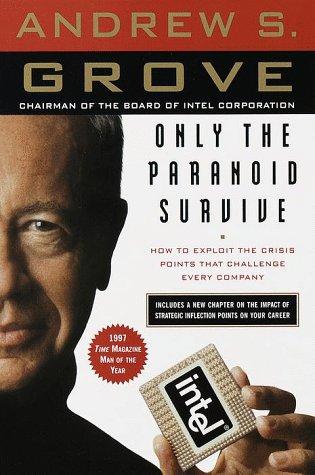
Only the Paranoid Survive is Andrew Grove's account of how he understood and navigated the most dangerous moments in a company's life — what he calls strategic inflection points. Grove was CEO of Intel during its most consequential decade, and the book is grounded in experience rather than theory. The central claim is that every business will eventually encounter a force powerful enough to transform it, and that most companies fail not because the change was unpredictable but because management refused to acknowledge it clearly enough to act.
Grove introduces the concept of the strategic inflection point — a moment when the fundamental competitive dynamics of an industry change so sharply that the old rules no longer apply. The cause can be technology, regulation, a new competitor, a change in distribution, or a shift in customer behavior. What matters is recognizing when one has arrived. Grove's diagnostic tool is asking whether any of the six forces acting on a business — competitors, customers, suppliers, substitutes, potential entrants, or complementors — has changed in a way that now rates "ten times" stronger than it did before.
What it gets right
- 1.
Strategic inflection points are moments when the fundamental competitive forces of an industry change so sharply that the old ways of operating no longer work.
- 2.
The '10x force' test: if any one of your six competitive forces has become ten times stronger, you are likely at or entering a strategic inflection point.
- 3.
Middle managers often sense inflection points before senior leadership because they are closer to customers, suppliers, and competitors. Hearing those signals is a management discipline.
What it covers
Who wrote it
Andrew S. Grove (1936–2016) was born in Budapest and survived both Nazi occupation and Soviet rule before emigrating to the United States in 1956. He earned a doctorate in chemical engineering from Berkeley and joined Intel at its founding in 1968. As CEO from 1987 to 1998, Grove oversaw Intel's transformation into the dominant microprocessor company of the personal computing era. He wrote several books, including High Output Management, and was named Time magazine's Man of the Year in 1997. He taught at Stanford Graduate School of Business for more than two decades.
